ITSM vs ITIL: Key Differences + What ITIL 5 Changes (2026)
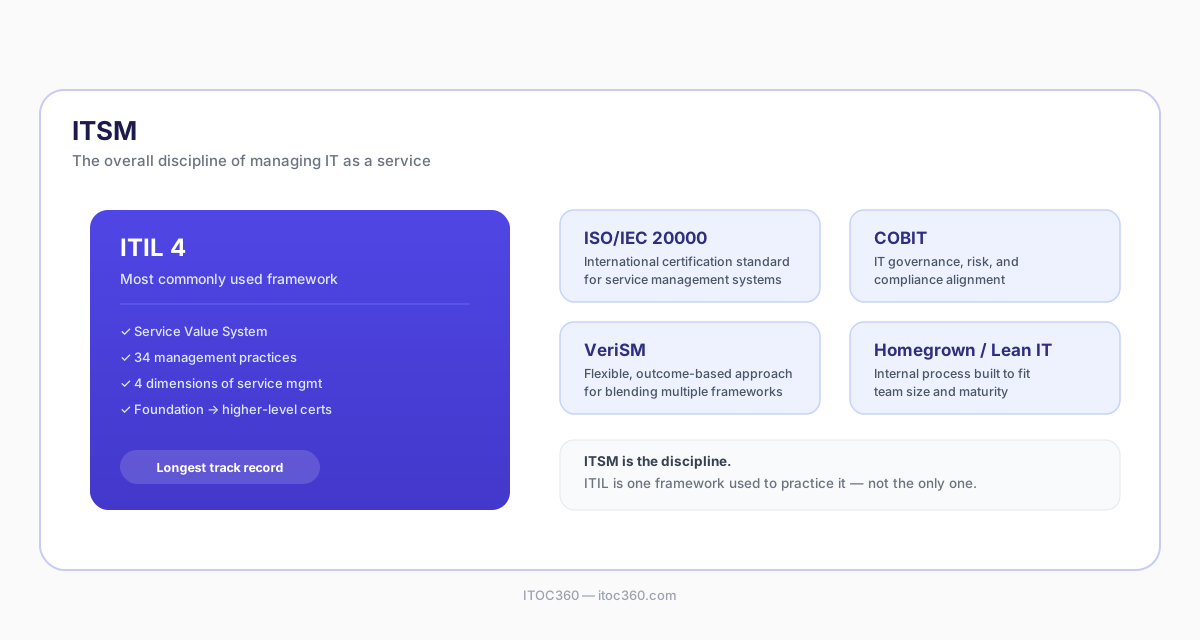
ITSM (IT Service Management) is the overall discipline of managing IT as a service: everything an organization does to deliver, support, and improve technology for the people who depend on it. ITIL is the most widely adopted framework for how to do ITSM well. ITSM is the "what"; ITIL is one specific, well-documented "how." Every ITIL practice is part of ITSM, but not every ITSM approach uses ITIL.
Quick answer: ITSM and ITIL are not interchangeable. ITSM is the discipline of managing IT services end to end (incidents, requests, changes, assets). ITIL is a specific set of best practices that many organizations adopt to structure their ITSM. The newest release, ITIL (Version 5), launched in January 2026; ITIL 4 is still valid and widely used during the transition. You can practice ITSM without ITIL, but ITIL only makes sense inside a broader ITSM approach.
The two terms get blurred constantly in vendor marketing, job postings, and certification pages. For the full picture of ITSM itself, see our guide on what ITSM is and how to choose a tool. This article focuses on where ITSM and ITIL diverge, what ITIL 5 changes, and what the difference means when you're running an incident or choosing a platform.
What Is ITSM?
ITSM is the practice of designing, delivering, managing, and continuously improving IT services for employees, customers, and partners. It treats IT not as a pile of servers and tickets, but as a set of defined, measurable services with owners, SLAs, and outcomes.
ITSM covers the same core processes regardless of which framework (if any) an organization follows:
Incident management
Problem management
Change management
Request fulfillment
Knowledge management
Asset and configuration management
Service level management
Any organization running a service desk, a ticketing system, or a defined on-call process is already practicing some form of ITSM, whether or not it has formally adopted a framework.
What Is ITIL?
ITIL is a structured framework of best practices for delivering and managing IT services. It was first developed in the 1980s by the UK government's Central Computer and Telecommunications Agency (CCTA). The name originally stood for IT Infrastructure Library; today "ITIL" is used as a brand name in its own right. The framework is owned by PeopleCert, which acquired AXELOS.
Two versions matter in 2026:
ITIL 4 (2019) replaced ITIL v3's rigid process lifecycle with the Service Value System (SVS), 34 management practices, and the four dimensions of service management. Most ITSM tools still use its vocabulary.
ITIL (Version 5) (January 2026) extends ITIL from service management to digital product and service management, and is designed to be AI-ready. Foundation is available now; further modules are rolling out in phases. See ITIL 4 vs ITIL 5 below.
ITIL isn't the only framework for ITSM. ISO/IEC 20000, COBIT, and VeriSM are common alternatives or complements. ITIL simply has the longest track record and the most tooling built around its terminology, which is why most ITSM platforms default to its vocabulary even when a team hasn't formally certified in it.
ITSM vs ITIL: The Core Differences
ITSM | ITIL | |
|---|---|---|
What it is | A discipline / practice area | A specific framework within that discipline |
Scope | Everything involved in managing IT as a service | A defined set of practices and guidance for doing so |
Flexibility | Combine multiple frameworks or build your own approach | Structured practices, terminology, and roles |
Current version | Not versioned | ITIL (Version 5), launched January 2026; ITIL 4 still in wide use |
Certification | No single certification (a practice, not a body of knowledge) | ITIL Foundation and higher-level certifications |
Ownership | Not owned by any vendor or body | Owned and licensed by PeopleCert (formerly AXELOS) |
Analogy | Project management as a discipline | Agile or Waterfall as a methodology within it |
The project management analogy is the easiest way to hold onto this. Project management is the discipline; Agile and Waterfall are methodologies for practicing it. ITSM is the discipline; ITIL is one methodology for practicing it.
Are ITSM and ITIL the Same Thing?
No. This is the most common misconception, mostly because the terms get used interchangeably in job titles and vendor copy. You cannot "do ITIL" outside an ITSM context, but you can "do ITSM" without ever adopting ITIL. Many organizations, especially smaller and fast-moving ones, run effective incident, change, and request processes without certifying anyone in ITIL.
How Are ITSM and ITIL Related?
ITIL is best understood as a toolbox inside the larger ITSM discipline. An organization typically:
Decides it needs a structured approach to managing IT services (that decision is itself "doing ITSM").
Evaluates frameworks: ITIL, ISO/IEC 20000, COBIT, VeriSM, or a homegrown mix.
Adopts the parts of a framework (most often ITIL) that fit its size, maturity, and industry requirements.
Implements those practices inside an ITSM platform or tool.
Most mature organizations don't adopt ITIL wholesale. They pull in the incident, change, and problem practices that map to real pain points and skip the rest. That is a very ITSM-native way of thinking: align process to business outcome, not process for its own sake.
ITIL 4 vs ITIL 5: What Changed?
ITIL (Version 5) is an evolution of ITIL 4, not a reset. PeopleCert launched it in January 2026 and is releasing it in phases, so ITIL 4 and ITIL 5 will run in parallel for a while. For the ITSM vs ITIL question, nothing fundamental changes: ITIL 5 is still a framework inside the ITSM discipline. What changes is its scope and emphasis.
ITIL 4 (2019) | ITIL (Version 5) (2026) | |
|---|---|---|
Scope | IT service management | Digital product and service management across the full lifecycle |
AI | Not a core theme | Positioned as "AI-native"; adds an ITIL AI Governance extension module |
Structure | Service Value System, 34 practices, four dimensions | ITIL Value System, 34 practices, product-and-service lifecycle view |
Practice access | Practice guides | All 34 practices via a membership model |
Advanced modules | Specialist / Strategist / Leader modules | ITIL Product, Service, Experience, Strategy, Transformation |
Designations | Managing Professional, Strategic Leader, ITIL Master | Practice Manager, Managing Professional, Strategic Leader, ITIL Master |
Exams | Closed-book multiple choice | Foundation closed-book; open-book planned for advanced modules |
Renewal | Three-year renewal | Three-year renewal; an ITIL 5 certificate can renew ITIL 4 certificates |
Two details matter for incident and on-call teams:
Incident management now sits in a named practice bundle. The ITIL 5 Practice Manager path includes a "Monitor, Support and Fulfil" specialization covering service desk, incident, problem, service request, and monitoring and event management. That grouping mirrors how modern operations teams actually work: detection, alerting, and response as one flow. For how two of these practices run day to day, see ITIL 5 incident management and ITIL 5 problem management.
Existing certifications still count. ITIL 4 Foundation is accepted as a prerequisite for upper-level ITIL 5 modules, and a shorter ITIL Foundation Bridge (Version 5) exists for people who want the Version 5 certificate. ITIL v3 Foundation is not accepted.
ITSM vs ITIL in Practice: A Real Incident Walkthrough
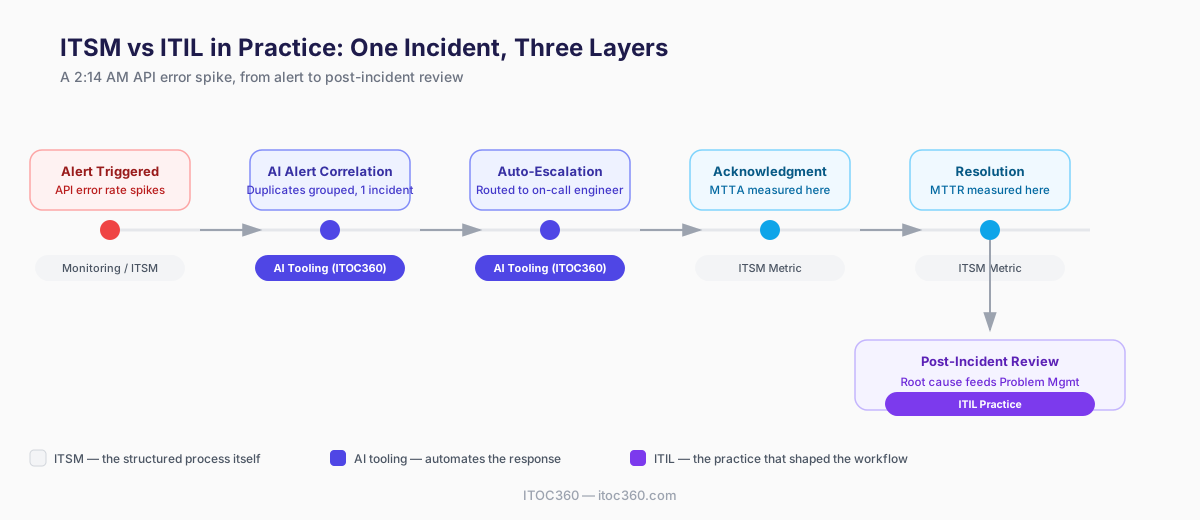
Definitions only go so far. Here's where the distinction actually matters: during an incident.
The scenario: A production API starts returning elevated error rates at 2:14 AM.
Where ITSM shows up: ITSM is the reason a defined process exists at all. There's a ticketing system, an on-call rotation, an SLA saying P1 incidents need acknowledgment within 5 minutes, and a runbook the responding engineer can follow. None of that is ITIL-specific; it's structured IT service delivery.
Where ITIL shows up: ITIL's incident management practice shaped how that process was designed. It separates incidents from problems, defines severity levels, requires a post-incident review, and feeds root-cause data into problem management so the same failure doesn't recur. The vocabulary ("major incident," "known error," "service request" vs. "incident") is ITIL's, even if nobody on the team says "ITIL" out loud. The response typically follows a runbook built from that same ITIL-shaped process.
Where incident orchestration fits in: This is where a purpose-built incident tool earns its place next to a core ITSM platform. Instead of a human triaging dozens of duplicate alerts from one root cause, a tool like ITOC360 uses machine learning to correlate related alerts into a single actionable incident. It then escalates to the right on-call engineer by voice, SMS, Slack, Teams, or email, following a defined escalation policy. Fewer duplicate pages means faster acknowledgment, which shows up directly in MTTA and MTTR: the two metrics that prove whether ITSM and ITIL are working, rather than just documented.
This is the piece most comparisons skip. ITSM and ITIL describe what good looks like on paper. What closes the gap between "documented process" and "5-minute acknowledgment at 2 AM" is increasingly the tooling layer: incident management software that automates the parts of the ITIL incident lifecycle that used to depend on someone being awake and paying attention.
Do You Need ITIL Certification to Practice Good ITSM?
No, but it helps in specific situations. ITIL Foundation certification is useful when:
You're building a team and want a shared vocabulary across candidates and vendors.
You operate in a regulated industry where auditors expect a documented framework.
You're joining an enterprise that has already standardized on ITIL.
If you're starting fresh in 2026, ITIL Foundation (Version 5) is the natural entry point. If you already hold ITIL 4 Foundation, you don't need to retake it to progress to advanced ITIL 5 modules.
Certification is less critical when:
You're a small or fast-moving team where a lightweight, homegrown process already works.
Your priority is resolving incidents quickly, not passing an audit.
You're evaluating tools on what actually reduces MTTA and MTTR, not on certification logos.
The certificate itself doesn't resolve incidents faster. It standardizes vocabulary and process design, nothing more.
How Do You Choose an ITIL-Aligned ITSM Tool?
If you want ITIL alignment specifically, check for the following:
What to check | Why it matters |
|---|---|
Native incident / problem / change / release hierarchy | ITIL distinguishes these explicitly; a tool that flattens them into generic "tickets" makes reporting and root-cause analysis harder |
Major incident workflow | ITIL treats major incidents as a distinct process with its own escalation path, not just a "high priority" tag |
CMDB / asset relationships | Needed for configuration management and for understanding change impact |
SLA tracking by category | Service level management depends on measuring against defined targets, not just "time open" |
Monitoring and event integration | ITIL 5 groups monitoring and event management with incident management; alerts should flow into incidents without manual copying |
An incident orchestration layer | Core ITSM platforms are strong at structured workflows but often weaker at real-time alert correlation and on-call escalation; a dedicated incident response layer closes that gap |
ITIL-aligned KPI reporting | MTTA, MTTR, change success rate, and SLA compliance should be visible out of the box |
As a pattern, platforms built around ticketing and documentation tend to be strong on ITIL process but weaker on real-time response; AI-native incident tools tend to be the reverse. Many organizations run both: a core ITSM system of record plus a specialized layer for the moment something breaks.
ITSM vs ITIL: Key Takeaways
ITSM is the discipline of managing IT as a service; ITIL is the most widely used framework for practicing it.
You can run ITSM without ITIL, but ITIL only makes sense inside an ITSM context.
ITIL (Version 5) launched in January 2026 and widens ITIL to digital products and AI; ITIL 4 remains valid during the transition.
The difference shows up most clearly during an incident: ITSM is the process, ITIL shaped the process, and automation makes it fast enough to matter.
An "ITIL-aligned" tool has real incident/problem/change hierarchies and ITIL-native KPI reporting, not just a vendor badge.
Frequently asked questions
Is ITIL a certification or a framework?
Both. ITIL is a framework of best practices with an associated certification path (ITIL Foundation and higher levels) managed by PeopleCert.
Can you have ITSM without ITIL?
Yes. ITSM just means managing IT as a structured service. You can do that with ITIL, with another framework like ISO/IEC 20000, or with your own internal process.
What is the latest version of ITIL?
ITIL (Version 5), launched by PeopleCert in January 2026. It is being released in phases: Foundation is available now, and advanced modules follow over time.
Is ITIL 5 replacing ITIL 4?
Not immediately. ITIL 4 and ITIL 5 run in parallel during the transition, and ITIL 4 Foundation is accepted as a prerequisite for advanced ITIL 5 modules.
Is ITIL 4 very different from ITIL v3?
Yes, structurally. ITIL v3 was built around sequential lifecycle processes. ITIL 4 replaced that with 34 flexible practices and a Service Value System designed to work with Agile and DevOps.
What is an ITIL-aligned ITSM tool?
A platform that supports ITIL's core practices natively: distinct incident, problem, change, and release workflows, a CMDB, SLA tracking, and ITIL-relevant KPI reporting.
Does adopting ITIL slow teams down?
It can, if applied rigidly or all at once. Most fast-moving teams adopt the practices that solve a real pain point (usually incident and change management) and skip the rest.
Who owns ITIL?
PeopleCert, which acquired AXELOS and its portfolio. That's a licensing detail; it doesn't change how the framework is used day to day.
Final Thoughts
ITSM and ITIL aren't competing concepts, and they aren't synonyms. ITSM is the destination; ITIL is one well-worn map, now in its fifth edition. The distinction matters most for two practical decisions: how much formal framework your team actually needs, and whether your tooling turns that framework into something that holds up at 2 AM, not just in a process diagram.
Related Reading
What Is ITSM? Definition, Processes, KPIs & How to Choose a Tool
MTTR: Mean Time to Resolve
Sources
PeopleCert — ITIL (Version 5) explained
PeopleCert — ITIL Foundation (Version 5)
PeopleCert — ITIL Foundation Bridge (Version 5)
Wikipedia — ITIL
ISO — ISO/IEC 20000-1:2018
ISACA — COBIT
Advised Skills — ITIL (Version 5) in 2026: what is confirmed (qualification structure and exam details)