








Every alert that fires is not an incident, and every incident is not the same. When thousands of signals flood your operations center daily, the difference between a five-minute fix and a five-hour outage often comes down to one thing: correctly identifying the incident type. This guide breaks down what incident types are, why they matter, and how to use them to make your response process faster and more reliable.
What Is an Incident Type?
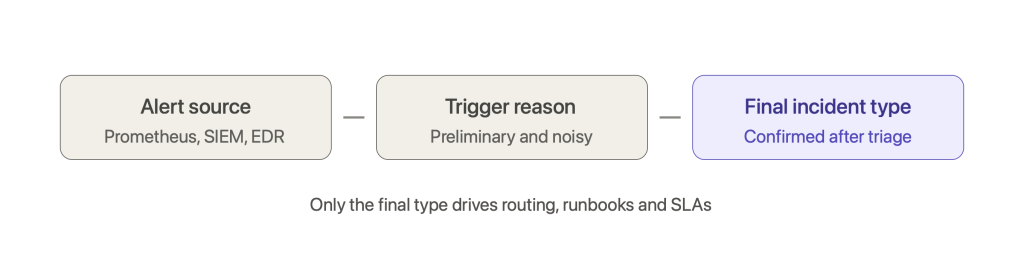
An incident type is the standardized label assigned to a confirmed issue that describes what actually happened-not just why an alert fired. In emergency services, the incident type defines what was found at the scene. In IT and security operations, the same principle applies: it captures the verified reality after investigation, not the initial noise.
There are three layers worth distinguishing:
- Alert source – the monitoring tool (ex: Prometheus, Grafana, a SIEM) that generated the signal.
- Trigger or dispatch reason – why the ticket was opened (“HTTP 500 error spike,” “CPU threshold exceeded”). This is preliminary and often noisy.
- Final incident type – the confirmed description of what is actually occurring, determined after triage. This is the label that drives every downstream action.
In ITOC360, each incident type is a core object used by the AI orchestration engine to group related alerts into a single, meaningful case and route it to the correct on-call engineer or security analyst.
Concrete examples of incident types used in real operations:
- “API gateway timeout impacting checkout flow”
- “Ransomware detected on file servers”
- “Vehicle fire damaging fiber conduit causing regional network outage”
- “Database schema migration rollback failure”
Why Getting the Incident Type Right Matters
Accurate incident typing directly reduces MTTA and MTTR, strengthens service reliability, and keeps your organization compliant with SLAs. When the type is wrong, the wrong people get paged, the wrong runbook is executed, and resolution time balloons.
Here is what correct incident types drive:
- Routing – the right responders are dispatched. A “network edge outage” goes to the network team; a “credential stuffing” incident goes to SecOps.
- Runbook selection – each specific incident type triggers a predefined remediation path.
- SLA/OLA enforcement – a security breach type may invoke stricter legal deadlines than a minor latency incident.
- Escalation chains – severity and type together determine when to page leadership or notify customers.
Classification of incidents aids in resource allocation and identifying trends. Accurate incident typing also influences required information for reports-quarterly trend analysis reveals which services are chronically noisy, enabling capacity planning and staffing adjustments. FreeWheel’s NOC, for example, achieved a 78% reduction in MTTR after implementing better incident typing and correlation, with alert noise dropping roughly 90%.
Consider how fire and emergency services handle this: a vehicle fire and a structure fire demand entirely different apparatus, personnel, and station response. Critical events-those causing major harm, long-term illness, or death-trigger maximum resources. The IT parallel is identical: “network edge incident” vs. “application performance incident” require different teams, tools, and urgency.
Operational impacts of misclassification can include staff absenteeism from burnout, equipment downtime from delayed fixes, and loss of productivity across the business. Incidents can also carry financial costs including medical treatment and regulatory fines when security or safety incidents are mishandled.
Core Categories of Incident Types in IT and Security
Just as emergency management systems have AID, FIRE, and RESCUE families, IT and security operations use high-level incident type families for consistency. Organizations may classify incidents by event type and hazard type. Types of workplace incidents include injuries, near misses, property damage, and security threats-and digital operations mirror this hierarchy.
- Infrastructure & Network – datacenter network outage, BGP routing flap, ISP link failure.
- Application & API – checkout API latency spike, release regression causing error rates above 5%.
- Security Incidents – credential stuffing, ransomware detection, phishing campaign targeting internal staff.
- Data & Storage – database replication lag, misconfigured S3 bucket with public access, data corruption during backup.
- Compliance & Audit – PCI scope violation, GDPR breach notification requirement.
- User Experience & Customer Impact – login failure spike, session timeouts on mobile app, payment checkout errors.
- Third-Party & Vendor – cloud provider regional outage, payment processor downtime.
- Environmental & Physical – vehicle fire affecting fiber path, cooling system failure causing rack overheat, power failure in a data center zone. Property damage incidents here involve destruction of company assets without necessarily harming people.
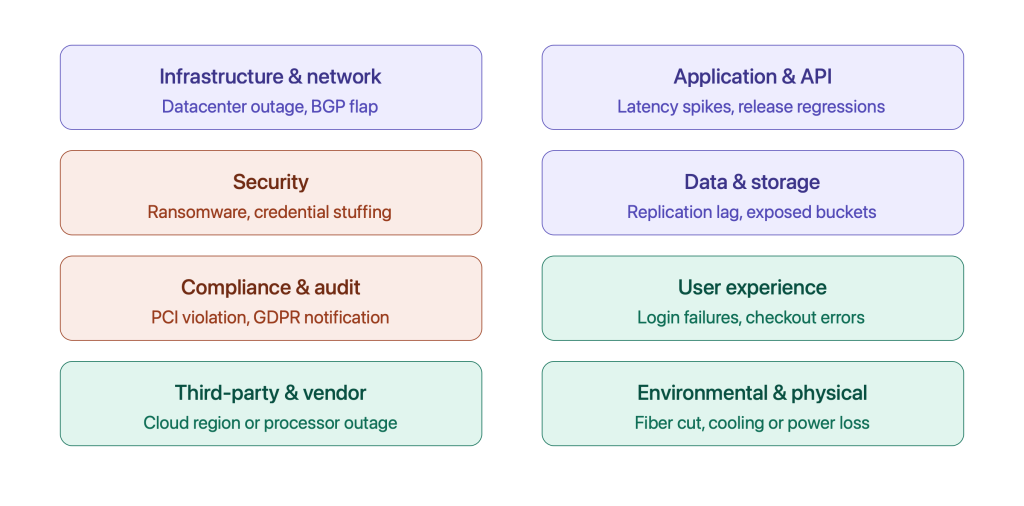
Each category contains multiple child types. Near misses-events that do not cause injury but have the potential to do so-should also exist as a category, since OSHA recommends investigating injuries, illnesses, near misses, and reported hazards. Workplace incidents can range from minor slips to severe structural failures, and safety incidents include slips, trips, falls, and cuts from machinery, all of which may be relevant in hybrid IT-physical environments.
Mapping Alerts to Incident Types in ITOC360
Large organizations receive thousands of raw alerts daily from tools like Prometheus, Datadog, Splunk, and EDR platforms. The challenge is not generating alerts-it is making sense of the noise.
Here is how ITOC360’s AI-driven orchestration maps alerts to incident types:
- Correlate related alerts – multiple signals about high latency, 500 errors, and dependency failures are grouped into one incident rather than dozens of tickets.
- Infer the most probable incident type – the engine uses alert content, service topology, historical cases, and runbook metadata to select or suggest a type.
- Dynamically adjust – as new alerts arrive and evidence shifts (ex: initial CPU spike later traced to a memory leak), the incident type evolves accordingly.
Example flow:
- Several “HTTP 500 error rate” alerts fire from the Payment API.
- Database latency starts rising.
- Customer support tickets spike for checkout failures.
- ITOC360 groups all signals under one incident: “Critical Application Incident – Payment API Degradation,” then routes it to the payment squad via alert routing rules.
Users can define custom incident types and mapping rules-including for physical hazards like a vehicle fire impacting infrastructure-through the platform’s settings. Notifications can be configured to reach teams via Slack, email, or other fields your workflow requires.
Standardizing Incident Types: Codes, Subtypes, and Naming Rules
In emergency management, incident types are categorized by series like 100, 200, 300. The 100 series incidents include various types of fire. FEMA classifies incidents from Type 5 as the least complex to Type 1 as the most complex; a Type 5 incident can be resolved within a few hours and generally requires minimal resources. Aircraft emergencies cover various incidents both in-flight and on-ground, and a multi-casualty incident involves significant casualties from events. Flooding incidents require emergency water removal or diversion. Even police departments use standardized codes for dispatch.
Mature IT operations should adopt a similar coded hierarchy:
| Code | Category | Example Incident Type |
|---|---|---|
| 1101 | Infrastructure | Network Outage – Data Center Region A |
| 2102 | Application | API Latency Incident – Checkout Flow |
| 3105 | Security | Phishing Campaign – Internal Staff |
| 4101 | Vendor | Cloud Provider Regional Outage |
| 5203 | Physical | Cooling System Failure – Rack 24–30 |
Incident types can be categorized by complexity in IT as well: a Type 5-equivalent might be a single-service restart, while a Type 1 is a full platform outage requiring cross-team war rooms.
Remarks and notes fields remain essential. Engineers should enter steps taken, root cause details, and workaround description beyond what the code captures. For naming conventions, keep names concise and technology-agnostic where possible-“Public API Gateway Degradation” rather than “Kong Crash”-so the taxonomy remains stable as tooling changes.
Introducing a New Incident Type
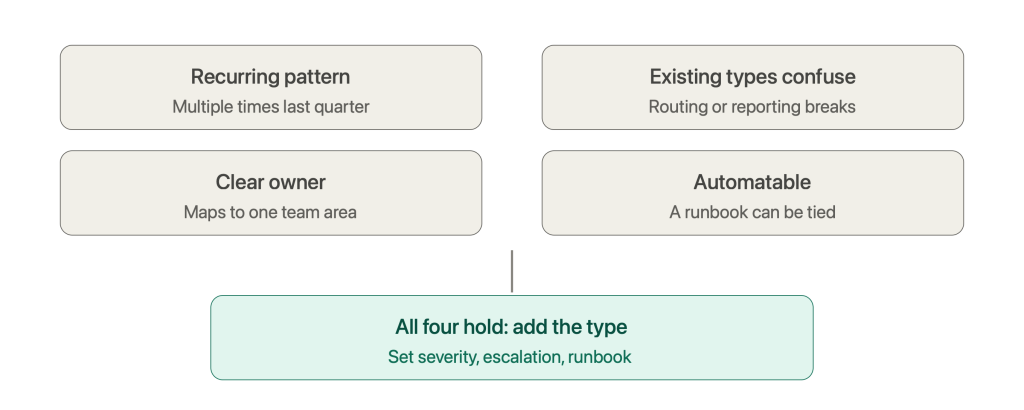
Not every pattern deserves its own type, but when a recurring failure keeps getting shoehorned into a generic category, it is time to add a new incident type. Incident type data supports data-driven decision-making here.
A simple decision test:
- The pattern has occurred multiple times in the last quarter.
- Existing types cause confusion in routing or reporting.
- The incident maps clearly to a consistent owner or team area.
- A runbook or automation can be tied to this pattern.
Example: A SaaS company repeatedly experiences “expired OAuth token for POS devices,” initially logged as a generic “Authentication Incident.” After the third occurrence, the SRE team introduces a new incident type-“POS OAuth Token Expiry Incident”-with its own on-call schedule and automated remediation runbook.
In ITOC360, creating a new incident type involves a straightforward process: navigate to incident type settings, click to add, select the parent category from a dropdown, enter the display name and code, and configure default severity, escalation policy, and linked runbooks. You can copy an existing type as a starting template and modify it, or build from scratch. Every added type becomes immediately available to the AI engine for classification.
Incident Types for Security Incidents and Physical Hazards
Many organizations run IT operations and security operations on the same observability stack. Consistent incident type definitions across both domains ensure nothing falls through the cracks. Incident type helps tailor resources to department needs-a security threat requires different responders than an infrastructure failure.
Typical security incident types:
- Unauthorized access attempt – repeated failed logins, brute force detection.
- Malware or ransomware detection on critical servers.
- Data exfiltration or suspicious large data movement.
- Phishing campaign targeting internal staff.
- Cloud misconfiguration – publicly exposed S3 bucket, overly permissive IAM role.
Physical hazards modeled as incident types when they affect digital services:
- Vehicle fire damaging fiber paths on a highway segment, causing regional connectivity issues.
- Electrical fire in a colocation cage leading to partial rack shutdown.
- Unauthorized physical access to a server room, badge misuse, or camera tampering.
ITOC360 correlates alerts from monitoring tools, SIEM platforms, and physical security systems into a unified incidentwith cross-team escalation-so that facilities staff, SRE, and SecOps all present on the same response thread.
Best Practices for Maintaining an Incident Type Taxonomy
Taxonomy maintenance should be part of every post-incident review. Without regular upkeep, categories drift and reporting loses meaning.
- Quarterly review – examine the top 20 incident types by count and total downtime minutes. Identify which types cause the most harm to service reliability.
- Deprecate and merge – remove unused or overlapping types. Update dashboards accordingly.
- Cross-team governance – involve representatives from DevOps, SRE, security, and NOC in taxonomy decisions. No single team should own the entire structure.
- Onboarding gates – ensure all new services select from approved incident types during onboarding. This is an extension of your service catalog discipline.
- Training – include incident type definitions in on-call handbooks and runbooks so new team members use them consistently from day one.
Use platform reports to detect recurring patterns by environment or region, and to prioritize automation for the top five incident types that are perfect candidates for self-healing.
How ITOC360 Helps You Operationalize Incident Types
ITOC360 is an AI-powered incident orchestration platform built for organizations with large, modern infrastructures. Here is what it does with incident types:
- Automatically classifies incoming cases into the appropriate incident type based on alert context, topology, and historical data.
- Suggests updates to the type during investigation if new evidence contradicts the initial classification.
- Routes incidents to the correct on-call engineer or responder group depending on type-network team vs. application squad vs. security operations center.
- Applies escalation policies, communication templates, and runbooks tied to each incident type.
- Integrates with major monitoring tools (Prometheus, Grafana, Datadog, New Relic, Elastic), ITSM platforms (Jira, ServiceNow), and SIEM/EDR systems for security incidents.
A well-maintained incident type taxonomy turns reactive firefighting into structured, measurable operations. Start by mapping your current alert noise into a clear set of incident types, then run a pilot with ITOC360 to measure the MTTA/MTTR improvements and noise reduction firsthand.