Incidents in IT systems vary widely in their impact and urgency. From minor glitches that barely affect users to catastrophic outages that bring entire services to a halt, understanding and managing these incidents effectively is crucial for modern
What Is a SEV1 Incident? Severity Levels, Response, and Prevention
A SEV1 incident is the highest severity classification in incident management: a critical failure that takes down a core service for all or nearly all users, with no workaround available. It requires immediate escalation, a dedicated incident commander, and an all-hands response until the service is restored.
Everything below expands on that definition — how SEV1 differs from lower severity levels, how it relates to P1 priority, what the first fifteen minutes of a SEV1 response should look like, and how to reduce how often you have one.
Incident Severity Levels at a Glance
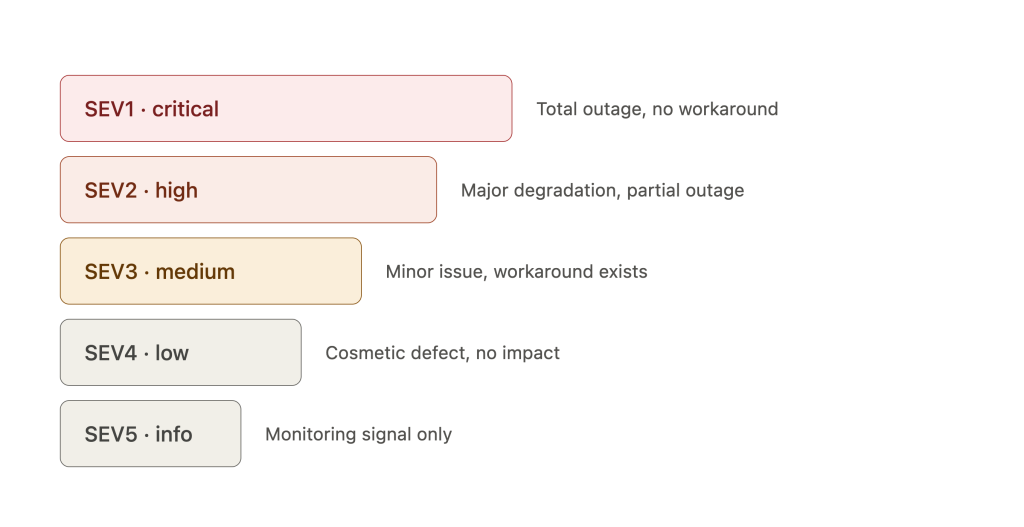
Severity levels are a standardized scale for classifying incidents by their impact on users and business operations. Most organizations run a five-level model, though four is also common.
Level
Impact
Users affected
Workaround
Response expectation
Example
SEV1 — Critical
Total outage of a core service, data loss, or confirmed breach
Major degradation or partial outage of a key service
20–80%, or one critical function
Painful or partial
Immediate during business hours; on-call paged 24/7
Checkout succeeds but confirmation emails fail
SEV3 — Medium
Minor functional issue or performance degradation
Small subset
Yes, usable
Next business day; standard queue
Search results slow for one region
SEV4 — Low
Cosmetic defect, no measurable business impact
Few or none
Not needed
Scheduled into normal sprint work
Misaligned button on settings page
SEV5 — Informational
Monitoring signal or internal tracking item
None
N/A
Logged, reviewed in aggregate
Disk usage crossed a warning threshold
The value of this table is not the labels — it is that everyone in the company reads the same row and reaches the same conclusion. When a severity level is announced, leadership, support, and engineering should all know what happens next without asking.
Why severity levels matter
Clear communication. “SEV1” carries more information in four characters than a paragraph of description, and it carries the same information to every listener.
Coordinated response. Severity triggers predefined escalation paths, paging rules, and communication plans.
Prioritization by measurement, not volume. The loudest alert is rarely the most important one. Severity separates impact from noise.
Resource allocation. An incident commander can pull people off planned work with a defensible justification.
Better post-incident data. Severity tagging is what lets you answer “are we having more critical incidents this quarter than last?”
What Counts as a SEV1 Incident
A SEV1 is a critical outage or failure in a core system that severely affects all or nearly all users, disrupts business operations, causes data loss, or creates a security exposure.
The defining characteristics:
Complete or near-complete service outage.
80–100% of users affected, or a critical business function entirely blocked.
No available workaround. This is the test that matters most.
Immediate financial, operational, or reputational risk.
An all-hands-on-deck response is justified.
The “no workaround” test
Teams argue about severity most often because they are debating impact in the abstract. The faster question is: can an affected user accomplish what they came to do, by any route at all?
If yes — even if the route is slow, ugly, or requires support to walk them through it — the incident is almost certainly a SEV2. If no, and the blocked action is core to the product, it is a SEV1. This single question resolves most classification disputes in under a minute, which matters when the clock is running.
Examples of SEV1 incidents
A payment gateway outage preventing all customer transactions during peak business hours.
A global authentication service failure blocking login for every user.
A network or region failure causing loss of connectivity across multiple availability zones.
A confirmed data breach exposing sensitive customer information.
A database failure resulting in unrecoverable writes or corrupted records.
An expired root certificate breaking all API clients simultaneously.
What Is Not a SEV1
Severity inflation is a real and expensive problem. When everything is critical, nothing is: engineers stop trusting pages, response quality drops, and on-call burnout accelerates. These situations look severe but usually are not SEV1:
A total outage in a non-production environment. A staging environment being down is high severity for the team blocked by it, but it does not affect customers. Severity measures impact; this is a priority question, not a severity one.
A complete outage for a single customer. Even a large one. This is usually a SEV2 with a dedicated communication track, unless contractual exposure makes it genuinely business-critical.
Degraded but usable service. Slow is not down. If the median user completes their task in eight seconds instead of one, that is serious — and it is a SEV2.
A loud alert with no confirmed user impact. Monitoring can fire on infrastructure conditions that never surface to users. Confirm impact before declaring.
A near-miss. A failure that was caught and contained by automation is worth a post-incident review, not a war room.
The corrective habit is a mandatory downgrade review: if a SEV1 gets reclassified during the post-incident review, that is a healthy signal, not an embarrassment. Track how often it happens.
How to Assign a Severity Level
Assign severity from objective, measurable criteria rather than the loudest voice in the channel:
Percentage of affected users.
Impact on revenue-generating processes.
Availability of a workaround.
Data integrity or security risk.
Duration and timing — an outage at 03:00 on a Sunday is not the same event as one during a product launch.
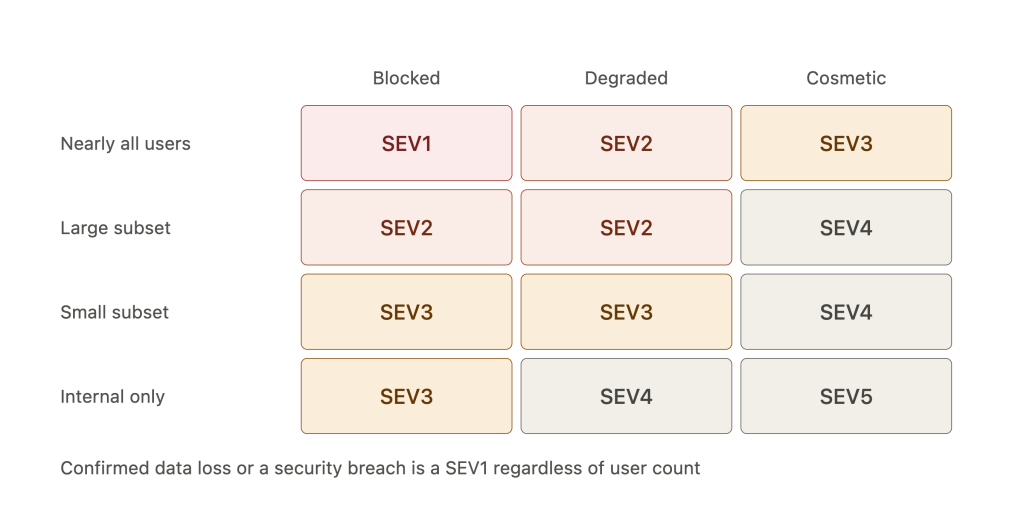
A severity matrix makes this repeatable. Scope on one axis, functional impact on the other:
Blocked (cannot complete task)
Degraded (slow or partial)
Cosmetic
All / nearly all users
SEV1
SEV2
SEV3
Large subset
SEV2
SEV2
SEV4
Small subset
SEV3
SEV3
SEV4
Internal only
SEV3
SEV4
SEV5
Two modifiers sit on top of the matrix. Confirmed data loss or a security breach is a SEV1 regardless of user count. And timing can escalate one level — a SEV2 during a peak sales window may warrant SEV1 handling.
Declare high, downgrade later. The cost of spinning up a war room for something that turns out to be a SEV2 is an hour of a few people’s time. The cost of under-classifying a real SEV1 is measured in customers.
SEV1 vs P1: Severity, Priority, and Urgency
These three terms are used interchangeably in most conversations and they should not be. They answer different questions.
Term
Question it answers
Set by
Changes during the incident?
Severity
How badly is this affecting users and the business?
Objective criteria and the severity matrix
Only if the actual impact changes
Priority
What do we work on first, relative to everything else?
Incident commander and business context
Yes, frequently
Urgency
How fast must this be resolved to prevent further damage?
Rate of escalating impact
Yes, as impact compounds
Some organizations use SEV1–SEV5 for severity and P1–P4 for priority. Others use P1–P4 as their severity scale and have no separate priority concept at all. Neither is wrong, but mixing the two conventions inside one company is a reliable source of confusion during an incident. Pick one and document it.
Where teams use both, the default mapping is straightforward:
Severity
Default priority
When it diverges
SEV1
P1
SEV1 in staging → P3; no customer impact
SEV2
P1 or P2
SEV2 blocking a launch → P1
SEV3
P3
SEV3 affecting a customer in renewal → P2
SEV4
P4
Rarely
The point of separating them is that severity should stay stable and factual, while priority absorbs the business context. If you collapse the two, you lose the ability to say “this is objectively bad, but here is why we are not dropping everything for it” — and you corrupt your severity data for trend analysis.
The First Fifteen Minutes of a SEV1
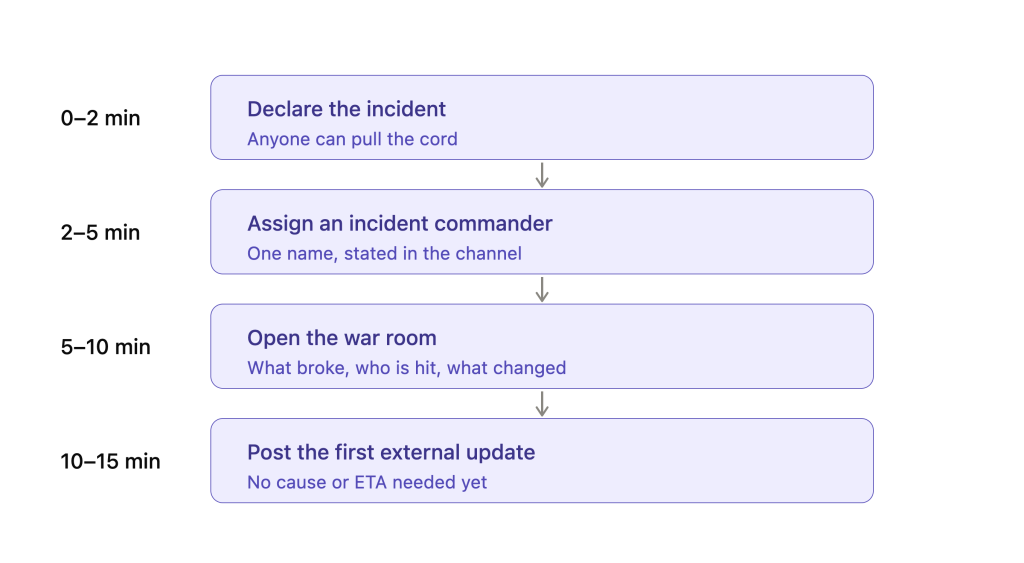
Most of the damage in a critical incident is done in the opening minutes, when nobody is sure who is in charge. A rehearsed sequence removes that ambiguity:
Minutes 0–2 — Declare. Whoever notices declares the SEV1. Declaration is not a privilege reserved for senior staff; anyone should be able to pull the cord. This is the single highest-leverage cultural rule in incident response.
Minutes 2–5 — Assign the incident commander. One named person, stated explicitly in the channel. If nobody claims it, the person who declared holds it until relieved. Roles that should also be named early: communications lead, and a scribe to keep the timeline.
Minutes 5–10 — Open the war room and assess. Spin up the dedicated channel or bridge. Establish three facts: what is broken, who is affected, and what changed recently. Recent deploys, config changes, and certificate expiries account for a large share of critical incidents, so check them first.
Minutes 10–15 — First external communication. Update the status page before customers start asking. The first message does not need a cause or an ETA; it needs to say that you know, and when you will speak again.
Then: mitigate before diagnosing. Restoring service and understanding the root cause are separate goals with separate timelines. Roll back, fail over, or shed load first. Root cause analysis belongs in the post-incident review, not the war room.
The Role of the Incident Commander
During a SEV1, the incident commander is the central point of accountability. Responsibilities:
Deciding severity classification and escalation.
Coordinating technical and business teams into one response.
Owning the internal and external communication plan.
Keeping the timeline accurate for the review that follows.
Leading the post-incident review.
Equally important is what the incident commander should not do: debug. The moment the IC is deep in a stack trace, nobody is coordinating, and the incident quietly loses its leader. The role is orchestration, not repair. The IC should also be a rotating position rather than always the most senior engineer available — the most senior engineer is usually the person you most need looking at the actual failure.
Communication During a SEV1
The war room
A SEV1 triggers a dedicated space — a Slack channel, a bridge, or both — where the response happens. An effective war room:
Centralizes communication so decisions are not scattered across DMs.
Runs status updates on a fixed cadence, typically every 15–30 minutes.
Records actions taken, impact assessments, and current estimated time to resolution.
Limits participation to essential responders, with a separate read-only channel for observers.
That last point matters more than it sounds. Executive presence in the working channel changes how engineers talk, and slows them down. Give observers a status document and protect the room.
Update cadence
Audience
Cadence
Content
War room
Every 15 min
Current state, actions in flight, blockers
Internal stakeholders
Every 30 min
Impact, ETA if known, next update time
Public status page
Every 30–60 min
Plain-language impact and next update time
Enterprise customers with SLAs
On declaration, then hourly
Direct outreach, named contact
Metrics That Matter
Metric
What it measures
Why it matters for SEV1
MTTA — mean time to acknowledge
Alert fired → human responding
Exposes gaps in on-call routing and escalation
MTTR — mean time to resolve
Declaration → service restored
The headline number, but it hides a lot
Time to declare
Impact begins → SEV1 declared
Often the largest and most fixable segment
Time to mitigate
Declaration → users unblocked
The number customers actually experience
SEV1 frequency
Count per quarter
Trend signal for systemic fragility
Repeat rate
Share of SEV1s with a recurring cause
Tests whether post-incident actions are real
Time to declare is the one most teams do not measure and should. If your MTTR is respectable but impact ran for forty minutes before anyone called it a SEV1, the problem is detection and culture, not engineering speed.
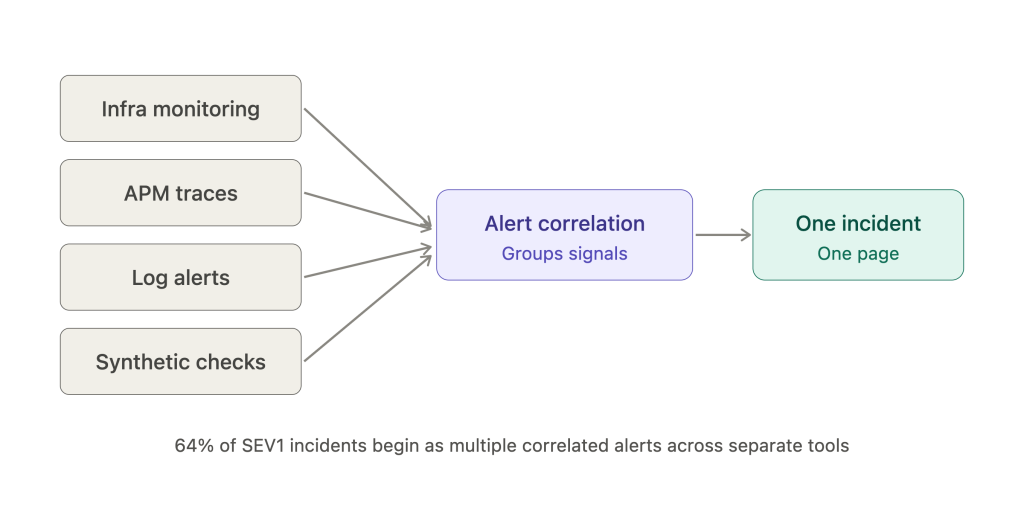
According to ITOC360’s aggregate incident data, 64% of SEV1 incidents initially trigger as multiple correlated alerts across fragmented monitoring tools. Teams using automated incident correlation and smart escalation reduced their median MTTA from 14.2 minutes to 1.8 minutes, while shaving an average of 22 minutes off their Time to Declare.
Preventing SEV1 Incidents
Prevention is far cheaper than response. Proactive incident management includes:
Monitoring and observability covering every critical service path, not just infrastructure health. Alert on user-visible symptoms.
Service level objectives and error budgets so degradation is visible before it becomes an outage.
Synthetic tests and health checks that exercise real user journeys, so you find failures before customers report them.
Incident response drills — scheduled game days that simulate SEV1 conditions. The first real SEV1 should never be a team’s first SEV1.
Runbooks kept current, linked directly from the alerts that trigger them.
Blameless post-incident reviews that produce tracked, owned action items rather than a document nobody reopens.
Also worth auditing: single points of failure that were acceptable at a smaller scale, and change-related risk. A large share of critical incidents trace back to a recent deploy or configuration change, which makes deploy safety — progressive rollout, fast rollback, change freezes during peak windows — one of the highest-return investments available.
How ITOC360 Supports SEV1 Response
Managing a critical incident well depends on removing manual steps from the opening minutes:
Alert correlation consolidates related alerts into a single incident, so a cascading failure pages the team once rather than eighty times.
Automatic severity tagging suggests a level from impact patterns, speeding up triage and reducing classification disputes.
Intelligent routing assigns the incident to the right on-call engineer, with backup escalation already defined.
Automated escalation moves the page up the chain if it is not acknowledged inside a set window, so no critical incident depends on one person’s phone.
War-room orchestration creates the channel with roles, runbooks, and incident context already attached.
Together these compress the segments of the timeline that are pure coordination overhead — time to acknowledge, time to declare, and time to assemble the right people.
Post-Incident Review
Every SEV1 earns a review. A useful one covers:
Timeline. What happened, when, and what each responder knew at the time.
Impact. Users affected, duration, revenue or SLA consequence, in numbers.
Response assessment. Was the severity classification correct? Where did the timeline stall?
Contributing factors. Plural, and systemic. Complex failures rarely have a single root cause.
Action items. Owned, dated, and tracked in the same system as normal work — otherwise they do not happen.
Blameless framing. The question is what conditions made the failure possible, not who typed the command.
Review the reviews quarterly. If the same contributing factor appears three times, the action items from the first two were not real.
Summary
A SEV1 incident is a critical failure affecting all or nearly all users with no workaround, requiring immediate coordinated response. Getting SEV1 handling right rests on a few things:
Classify from objective criteria, and use the “no workaround” test to settle disputes fast.
Keep severity, priority, and urgency as separate concepts — collapsing them corrupts both your response and your data.
Let anyone declare, name an incident commander who does not debug, and communicate on a fixed cadence with a committed next-update time.
Mitigate first, diagnose later.
Measure time to declare, not just MTTR.
Invest in prevention and drills, because the cheapest SEV1 is the one that never happens.
Done consistently, critical incidents stop being chaotic crises and become repeatable, learnable events that leave the organization more resilient than it was.