Incident Response Roles and Responsibilities (2026 Guide)
Quick answer: Incident response roles divide the work of handling an incident so that one person coordinates, others fix, and someone keeps everyone informed. In IT operations and SRE, the core roles are the incident commander (owns decisions and coordination), the operations or technical lead (directs the hands-on fix), the communications lead (updates stakeholders and customers), the scribe (records the timeline), and subject matter experts (diagnose and repair specific systems). Security incident response teams (CSIRTs) use a related set: incident response manager, security analysts, forensic investigators, threat intelligence, plus legal and PR. Not every incident needs every role: a minor issue may be one engineer, while a major incident fills all of them.
The most common way an incident goes wrong has nothing to do with the bug. Five engineers join a call, all start investigating, two of them restart the same service at the same time, nobody tells customers anything for 40 minutes, and afterward no one can say when the fix actually went out.
Defined roles prevent that. They don't add bureaucracy; they remove the question "who's doing what?" at the moment nobody has time to answer it.
This guide covers both meanings of the term. First, the roles used in IT operations, SRE and DevOps response to an incident, with what each role does and doesn't do. Then the roles on a security incident response team. It also covers how to scale roles by severity, a RACI matrix by incident phase, and how to hand roles off without dropping anything. For the commander role in depth, see what is an incident commander.
What is an incident response team?
An incident response team is the group of people who take ownership of an incident from declaration to resolution, each with a defined role. In IT operations it's usually assembled on demand from on-call engineers, an incident commander rotation and a communications contact, and it disbands once the incident is closed. In cybersecurity it's often a standing team, the CSIRT, with permanent members and external specialists on retainer.
Either way, the team is defined by its roles rather than its headcount: a five-person team with clear roles responds faster than a twenty-person call where everyone investigates.
Incident response team roles and responsibilities at a glance
These are the roles most IT operations, SRE and DevOps teams use. Names vary between companies (incident manager, incident lead, incident coordinator), but the responsibilities are consistent. Google's SRE book describes the same split in its chapter on managing incidents: separate people for command, operational work, communication and planning.
Role | Owns | Does | Does not |
|---|---|---|---|
Incident commander (IC) | The incident as a whole | Sets priorities, assigns roles, makes final decisions, declares severity changes and the end of the incident | Fix things hands-on, or debug alongside the team |
Operations lead (technical lead) | The technical response | Directs the people working on the fix, proposes mitigation options, reports progress to the IC | Talk to customers or executives |
Communications lead | Everything said outside the response team | Posts status page and stakeholder updates on a fixed cadence, handles inbound questions, keeps executives informed | Make technical decisions or promise fix times the IC hasn't approved |
Scribe | The record | Logs decisions, actions and timestamps in the incident channel or timeline, tracks follow-ups | Join the debugging or the stakeholder discussion |
Subject matter experts (SMEs) | One system or component | Diagnose and repair their area, report findings to the operations lead | Change things outside their area without the operations lead's agreement |
Customer liaison (optional) | Affected customers | Works with support and account teams on customer-specific impact and follow-up | Post public updates without the communications lead |
Executive sponsor (optional, major incidents) | Business decisions | Approves high-impact trade-offs, such as taking a service fully offline or public disclosure | Direct the response |
The single most important line in that table is the first "does not": the incident commander doesn't fix the problem. An IC who starts debugging stops coordinating, and the incident loses its center.
Each role in detail
Incident commander
The incident commander, often shortened to the IC role, is the single point of coordination and the final decision-maker for the incident. The IC's job is to keep the response moving: confirm the severity, pull in the right people, assign the other roles, set a short-term goal ("stop the errors" before "find the root cause"), and decide when to escalate, roll back or close.
Who fills it: a trained engineer or engineering manager from an IC rotation, not necessarily the most senior person or the owner of the broken service. Being removed from the technical details is an advantage. For a full treatment, see incident commander: role and responsibilities.
Typical phrases: "Who's working on the database? What's your next step and when will you report back?" and "We're rolling back. Any objections in the next 60 seconds?"
Operations lead (technical lead)
The operations lead runs the technical work while the IC runs the incident. They coordinate the SMEs, keep investigation threads from overlapping, propose mitigation options to the IC with their risks, and translate technical progress into a status the IC can act on.
Who fills it: an engineer who knows the affected system well. On small incidents, the IC and operations lead are often the same person. On large ones, separating them is the first split to make.
Communications lead
The communications lead owns every message that leaves the response team: internal updates to leadership and support, status page posts, and customer notifications. They keep a fixed update cadence, even when there's nothing new to say, because silence is what triggers escalations and support tickets. See incident communication best practices and the ready-made incident communication templates.
Who fills it: someone who writes clearly under pressure, often from support, customer success or a dedicated incident team. It shouldn't be an engineer who's also fixing the problem.
Scribe
The scribe keeps the timeline: when the incident started, when it was detected and declared, every decision and who made it, every change applied, and when service recovered. They also collect follow-up items as they come up. That record becomes the backbone of the postmortem and the source of MTTA and MTTR data.
Who fills it: often a newer team member, which makes the role a good way to learn incident response. Automated timelines reduce the work but don't replace it: tools capture events, a scribe captures why decisions were made.
Subject matter experts
SMEs are the engineers who know a specific component: the database, the network, the payment integration, the deployment pipeline. They're paged in when their system is involved, work under the operations lead's direction, and step out once their part is done. A good runbook for their service shortens their ramp-up dramatically.
Customer liaison and executive sponsor
These two roles only appear in larger incidents. The customer liaison handles customer-specific impact, such as large accounts asking for direct updates, contractual SLA conversations, or credits, so the communications lead can focus on broad updates. The executive sponsor is a senior leader on call for decisions the IC shouldn't make alone: taking a revenue-critical service offline, public disclosure, or regulatory notification.
Security incident response team (CSIRT) roles
In cybersecurity, the incident is a breach, malware infection or unauthorized access, and the team is usually called a computer security incident response team (CSIRT). The structure looks different because the work includes investigation, evidence preservation and legal obligations, not just restoring service. The NIST SP 800-61 Rev. 3 guidance places incident response inside the broader cybersecurity risk management of the NIST CSF 2.0.
Security role | Responsibilities | Closest operations role |
|---|---|---|
Incident response manager (CSIRT lead) | Leads the response, sets priorities, coordinates internal and external parties, owns the decision to escalate | Incident commander |
Security analysts (often SOC tiers 1–3) | Triage alerts, confirm whether an incident is real, scope affected systems | Operations lead and on-call responders |
Forensic investigator (DFIR) | Preserves evidence, reconstructs the attack timeline, determines root cause | Scribe and SMEs combined, with a chain-of-custody duty |
Threat intelligence analyst | Identifies the attacker's tools and techniques and checks for related activity | No direct equivalent |
IT and system owners | Isolate, patch and restore affected systems under the CSIRT's direction | Subject matter experts |
Legal counsel | Advises on breach notification laws, contracts, evidence handling and law enforcement contact | Executive sponsor (partly) |
Communications / PR | Prepares internal, customer, regulator and media messages | Communications lead |
HR | Involved when an insider or employee conduct is part of the incident | No equivalent |
CISO or executive sponsor | Approves major decisions such as public disclosure or paying for external help | Executive sponsor |
External IR retainer | Specialist firm brought in for large or complex breaches | No equivalent |
Where the two worlds meet. Security detections still need a human to see them, often at night. Many security teams therefore route SIEM and EDR alerts through the same on-call and escalation system that operations uses, while the investigation stays with the CSIRT. When a security incident also causes an outage, both teams run in parallel: the CSIRT owns containment and evidence, and the operations IC owns service restoration. The two leads agree up front who can take systems offline.
How to scale roles by severity and team size
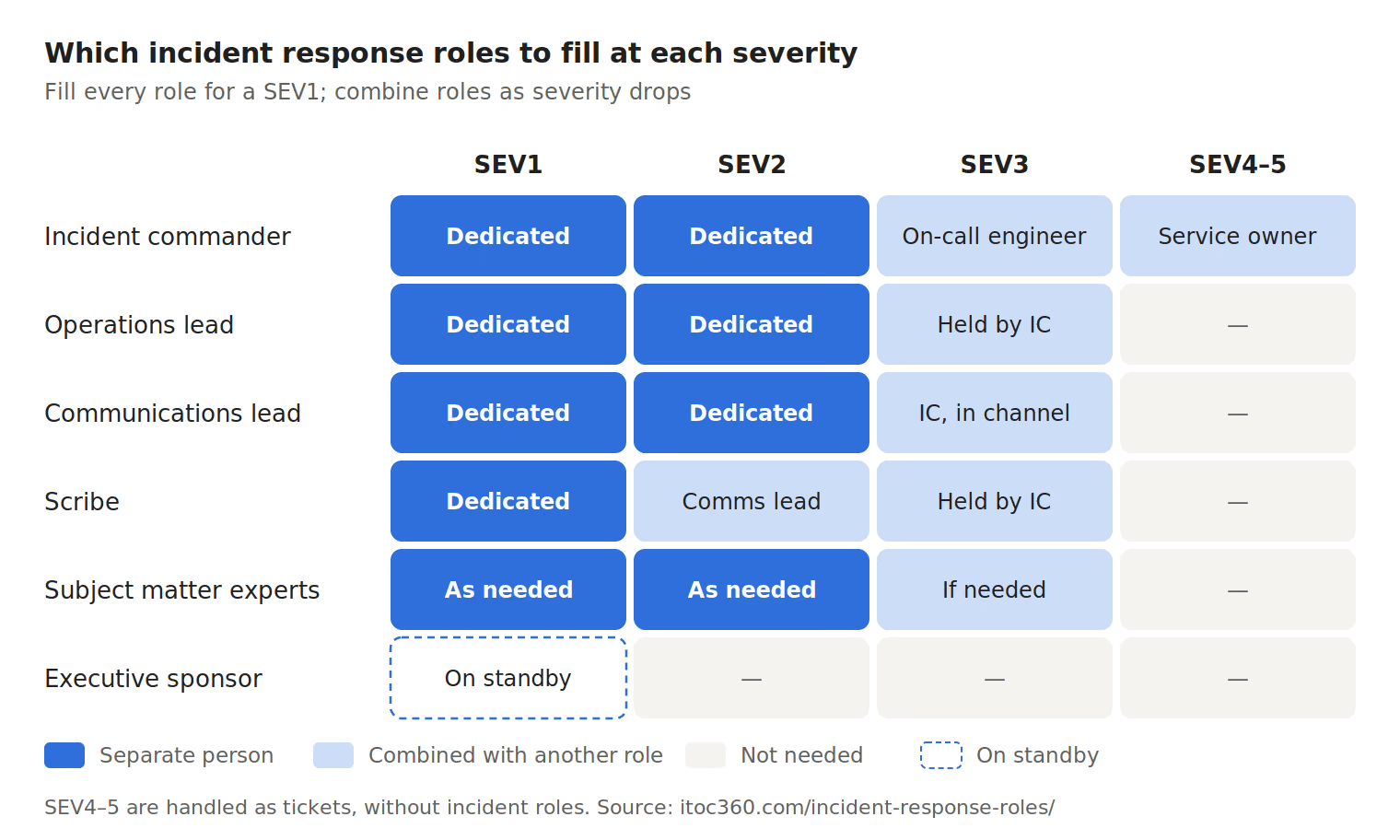
Roles are a toolkit, not a checklist. Filling every role for a minor incident wastes people; filling too few for a major one is how incidents spiral. Tie the staffing to your incident severity levels:
Severity | Typical impact | Roles to fill | Combined roles allowed |
|---|---|---|---|
SEV1 | Full outage or data loss for many customers | IC, operations lead, communications lead, scribe, SMEs, executive sponsor on standby | None: every role is a separate person |
SEV2 | Major feature down or severe degradation | IC, operations lead, communications lead, scribe, SMEs as needed | Scribe can be handled by the communications lead |
SEV3 | Partial degradation, workaround available | On-call engineer acts as IC; SMEs if needed | IC, operations lead and scribe in one person; updates posted in the incident channel |
SEV4–SEV5 | Minor issue, no user impact | Service owner | Handled as a ticket, no incident roles |
A SEV1 incident is usually also a major incident, which adds a fixed communication cadence and an executive update channel.
By team size. Small teams can't staff five separate roles, and don't need to:
Under 10 engineers: the on-call engineer is IC and operations lead. A second person takes communications and the timeline as soon as the incident is SEV2 or higher.
10–50 engineers: keep a separate IC rotation of three to six trained people. The communications role can come from support or product.
50+ engineers or regulated industries: a dedicated incident management function, with trained communications leads and a defined executive sponsor rotation.
Where the roles come from: the Incident Command System
Most technology incident roles are adapted from the Incident Command System (ICS), the framework emergency services use to coordinate fires, floods and disasters. PagerDuty's public incident response documentation, for example, is explicitly based on it. ICS organizes every response around five major functions:
ICS function | What it covers | Technology equivalent |
|---|---|---|
Command | Overall authority and decisions | Incident commander |
Operations | Doing the work to resolve the incident | Operations lead and SMEs |
Planning | Tracking status, documenting, planning next steps | Scribe, plus the IC's short-term plan |
Logistics | Getting the resources responders need | Access, tooling, extra responders, shift handoffs for long incidents |
Finance / Administration | Costs, contracts and claims | Vendor escalations, SLA credits, cost of emergency capacity |
Two ICS ideas matter most for engineering teams: a single commander for each incident, and a manageable span of control, so no one person directs more than a handful of others. When more than five or six SMEs are involved, the operations lead splits them into workstreams with their own leads.
RACI matrix: who does what in each phase
A RACI matrix makes ownership explicit for each step of the incident response lifecycle. R = Responsible (does the work), A = Accountable (owns the outcome; exactly one per row), C = Consulted, I = Informed.
Activity | Incident commander | Operations lead | Communications lead | Scribe | SMEs | Executive sponsor |
|---|---|---|---|---|---|---|
Declare the incident and set severity | A, R | C | I | I | C | I |
Assign roles | A, R | C | I | I | I | I |
Investigate and diagnose | A | R | I | I | R | — |
Choose a mitigation (rollback, failover, feature flag) | A | R | I | I | C | C (SEV1) |
Apply the fix | I | A | I | I | R | — |
Internal and executive updates | A | C | R | I | — | I |
Status page and customer updates | A | C | R | I | — | I |
Record the timeline and decisions | I | I | I | A, R | I | — |
Escalate or change severity | A, R | C | I | I | C | I |
Declare the incident resolved | A, R | C | I | I | C | I |
Schedule the postmortem and assign follow-ups | A, R | C | C | R | C | I |
Two things to notice. The IC is accountable for almost every row but responsible for very few: their job is to make sure things happen, not to do them. And only one role is accountable per row. If two people think they own the status page, nobody does.
How to assign, hand off and train incident roles
Assign roles out loud, in the first five minutes
The first person to respond is the IC until they hand the role to someone else. Their first message in the incident channel should name every role, even if one person holds several:
"I'm IC for this incident. Priya is ops lead, Marco is on comms, Sam is scribe. Current severity is SEV2. Next update at 14:30."
Naming roles publicly does two things: everyone knows whom to talk to, and anyone who joins late can read the channel and catch up without interrupting.
Hand off cleanly
Long incidents outlast people. Every role should be handed off at least every few hours on a long SEV1, and at the end of an on-call shift. A clean IC handoff covers four things:
Current state: what's broken, what's been ruled out, current severity.
Active workstreams: who is working on what, and when they'll report back.
Open decisions: anything waiting on approval, and pending customer or executive commitments.
The explicit switch: "Alex, you're now IC. I'm stepping back." Then the new IC confirms in the channel.
Until the switch is said out loud and confirmed, the old IC is still in charge. Silent handoffs are how incidents end up with two commanders or none.
Build rotations and train for them
Separate the IC rotation from the service on-call rotation. The engineer paged for a service shouldn't also be expected to command every incident. Define both in your on-call management setup and in your escalation policy.
Shadow before leading. New ICs shadow two or three incidents, then lead with an experienced IC shadowing them.
Practice on purpose. Game days and chaos experiments are low-stakes ways to rehearse roles, not just systems.
Write it down. Put role definitions, the severity-to-roles table and the handoff checklist in your incident response plan, and give responders a ready-made incident response template, so nobody has to remember them at 3 a.m.
Common mistakes with incident response roles
The most senior person becomes IC by default. Seniority and command are different skills. The best IC is trained, available and not needed for the fix.
The IC starts debugging. The moment the commander opens a terminal, nobody is watching the whole incident. If the IC is the only person who can fix it, they hand off command first.
Roles are never named. Everyone assumes someone else is updating customers. Name roles in the channel within the first five minutes, every time.
Too many people on the call. Twenty observers slow everything down. The IC invites SMEs by name and asks everyone else to follow the channel instead.
No communications lead on a SEV1. Engineers fixing the problem write updates late and in jargon, and support finds out from customers.
Silent handoffs. Someone logs off at the end of a shift without passing on what they were doing, and a workstream simply stops.
Roles exist only in a document. If people haven't practised them, the first real SEV1 becomes the training session.
Security and operations run separate responses without a shared lead agreement. One team takes a system offline for containment while the other is trying to restore it.
Where ITOC360 fits
Roles only work if the right people are in them within minutes. ITOC360 handles the mechanics so the incident commander can focus on decisions:
Roles assigned at declaration. ITOC360 Incident Response opens the incident with its roles, severity and timeline in place.
The right responders, paged automatically. On-call schedules and escalation policies in ITOC360 On-Call page the service owner, and a separate IC rotation if you run one, by voice, SMS, push, Slack or Microsoft Teams.
Run the response where the team already is. With ITOC360 ChatOps, responders acknowledge, update and hand off roles from Slack or Teams.
A communications lead with less to write. ITOC360 Status Pages keep customers updated from the same incident record.
A scribe's head start. Every alert, page, acknowledgment and escalation is timestamped automatically, so the scribe records the decisions and the reasons behind them, not the clock.
Frequently asked questions
What are the main incident response roles?
In IT operations and SRE, the core roles are the incident commander, operations or technical lead, communications lead, scribe and subject matter experts. Larger incidents may add a customer liaison and an executive sponsor. Each role has one owner during the incident.
What are the roles and responsibilities of an incident response team?
The incident commander coordinates and makes decisions. The operations lead directs the technical fix. The communications lead updates stakeholders and customers. The scribe records the timeline. Subject matter experts diagnose and repair their own systems. Together they separate coordinating, fixing and communicating so that none of them is neglected.
What are the roles on a cyber incident response team?
A computer security incident response team (CSIRT) typically includes an incident response manager, security analysts, forensic investigators, threat intelligence analysts, IT and system owners, legal counsel, communications or PR, HR when insiders are involved, and an executive such as the CISO. Large breaches may add an external incident response firm.
What does an incident commander do?
The incident commander owns the incident as a whole: confirms severity, assigns roles, sets priorities, decides on escalation or rollback, and declares the incident resolved. The IC coordinates the response rather than fixing the problem directly.
What is the difference between an incident commander and an operations lead?
The incident commander manages the incident: people, priorities, decisions and communication. The operations lead manages the technical work: which engineers investigate what, and which fix to apply. On small incidents one person often does both; on major incidents they should be separate.
Can one person hold more than one incident role?
Yes, on lower-severity incidents. On a SEV3, the on-call engineer usually acts as IC, operations lead and scribe. On SEV1 and SEV2 incidents, the incident commander and communications lead should always be separate people from those doing the fix.
What are the five major functions of ICS?
The Incident Command System is organized around Command, Operations, Planning, Logistics, and Finance/Administration. Technology teams map these to the incident commander, the operations lead and SMEs, the scribe, resourcing and handoffs, and vendor or cost decisions.
How do you define incident response roles for your team?
Start from your severity levels. Decide which roles each severity needs, who is eligible for each role, and which roles can be combined. Write a short definition of what each role does and doesn't do, set up an incident commander rotation, add the handoff checklist to your incident response plan, and practise in game days.
What are P1, P2, P3 and P4 incidents?
They're priority or severity levels, with P1 the most urgent. A P1 is a critical outage affecting many users, P2 a major degradation, P3 a partial issue with a workaround, and P4 a minor problem. Many teams use the equivalent SEV1 to SEV4 labels instead. The level decides which incident response roles are filled; see our guide to incident severity levels.