PagerDuty vs Opsgenie (2026): Features, Pricing, and What Opsgenie's Shutdown Means for You
Short answer
PagerDuty is the better choice in 2026 for most teams, for a simple reason: Opsgenie can no longer be bought. Atlassian stopped selling Opsgenie on June 4, 2025, and shuts it down on April 5, 2027. For existing Opsgenie customers, the real decision is between PagerDuty, Jira Service Management (Atlassian's official destination), or a purpose-built alternative.
If you are comparing the two as products, the trade-off has always been the same. PagerDuty is deeper and more expensive: 750+ integrations, advanced automation and AI, priced per user plus add-ons or as a platform subscription. Opsgenie was simpler and cheaper, with strong scheduling and tight Jira integration.
If you liked Opsgenie for its simplicity and price but need more than paging, the closest replacement is not PagerDuty but a full incident management platform with fair pricing. ITOC360 covers the whole incident lifecycle in one place: AI alert correlation, on-call scheduling and escalation, ChatOps incident response, runbook automation and AI-written retrospectives, with voice, SMS and incoming call routing in every plan, from $12 per user per month.
Key takeaways
Opsgenie is end-of-sale. No new purchases or plan changes since June 4, 2025. Access ends and unmigrated data is deleted on April 5, 2027.
PagerDuty changed its pricing. The public page now lists Free, Professional ($21 per user per month, billed annually) and a new PD Reliability Platform starting at $2,800 per year. Many comparisons still quote an old $41 Business tier.
Moving to Jira Service Management is not like-for-like. Voice notifications, heartbeats, global integrations and ChatOps incident management require JSM Premium or Enterprise.
New buyers are really choosing between PagerDuty, JSM and alternatives such as ITOC360, not between PagerDuty and Opsgenie.
PagerDuty vs Opsgenie at a glance
The table below compares the two tools as they stand in October 2026, with ITOC360 as a third reference point.
PagerDuty | Opsgenie | ITOC360 | |
|---|---|---|---|
Product status | Actively developed | End of sale June 4, 2025; shutdown April 5, 2027 | Actively developed |
Can new teams buy it? | Yes | No | Yes |
Free plan | 5 users, 1 schedule, 1 escalation policy, 100 SMS/phone notifications per month | 5 users (existing accounts only) | Free forever, includes SMS, voice and push |
Entry paid price | Professional: $21/user/month annual, $25 monthly | Essentials: $9.45/user/month (renewals only) | Foundation: $12/user/month, minimum 3 seats |
Platform pricing | PD Reliability Platform from $2,800/year (10 seats, 5,000 events) | Not applicable | Not applicable |
Integrations | 750+ | 200+ | 50+ monitoring tools |
Alert grouping / noise reduction | Requires AIOps add-on on Professional; included in Reliability Platform | Basic deduplication; AI grouping only after moving to JSM Premium | AI correlation included in every plan |
Incoming call routing | Add-on on Professional | Available; extra numbers $10/month each; JSM Premium+ only after migration | Included |
Status pages | External page with 250 subscribers on Professional | Requires Statuspage | Included |
Best for | Large enterprises with complex service maps and budget for add-ons | Existing Atlassian-centric teams until 2027 | Teams that want alerting, on-call and incident response in one platform, with simple pricing |
Sources: PagerDuty pricing, Atlassian Opsgenie pricing and end-of-sale notice, ITOC360 vs Opsgenie. Opsgenie integration count from incident.io's comparison.
Is Opsgenie shutting down? The dates that matter
Yes. Atlassian announced on March 4, 2025 that Opsgenie would stop being sold, and set a final shutdown date two years later. Every date below comes from Atlassian's Opsgenie pricing page, which carries the official notice.
Date | What happens |
|---|---|
March 4, 2025 | Atlassian announces end of sale and end of support. |
June 4, 2025 | End of sale. No new purchases, sign-ups or plan upgrades and downgrades. Existing customers can still add seats and renew, if the term ends before April 5, 2027. |
April 5, 2027 | End of support. Access is shut off, the product is no longer reachable, and any customer data not yet migrated is deleted. |
Atlassian's official path is an automated migration into Jira Service Management, with a recommended plan based on what you pay today:
Your Opsgenie plan | Atlassian's recommended JSM plan |
|---|---|
Free | JSM Free (or any paid plan) |
Essentials | JSM Standard |
Standard | JSM Premium |
Enterprise | JSM Premium or Enterprise |
The step up matters. A Standard customer is pointed to JSM Premium, because several Opsgenie features only exist there after migration (see the next section).
What you lose or pay more for in Jira Service Management
Atlassian publishes a full feature-change table. These are the changes on-call teams notice first:
Opsgenie capability | In Jira Service Management |
|---|---|
Voice call notifications | Premium and Enterprise only |
SMS notifications | Limited on Free; unlimited from Standard |
Heartbeat monitoring | Premium and Enterprise only |
Global integrations and bidirectional ITSM integrations | Premium and Enterprise only |
ChatOps incident management (Slack, Teams, Zoom) | Premium and Enterprise only; must be re-authenticated |
Incoming call routing | Premium and Enterprise only; Atlassian-owned numbers must be ported manually |
Stakeholder users | Premium and Enterprise only |
Incident Command Center | Deprecated |
Opsgenie REST API and API keys | Endpoints change; keys replaced by Atlassian tokens |
Edge Encryption | Replaced by bring-your-own-key |
MSP sub-accounts | Converted to free accounts that need their own migration |
If your team relies on phone calls at 3 AM, budget for JSM Premium, not Standard. That single line often decides whether JSM is cheaper than PagerDuty.
On-call scheduling, alerting and escalation
Both tools cover the core job well: build a rotation, route an alert to whoever is on call, and escalate if nobody acknowledges. The differences are in depth, limits and where each feature sits on the price list.
On-call scheduling
Opsgenie's scheduler is the part users miss most. Rotations, overrides and the final schedule sit on one screen with a calendar and timeline switch, which makes it easy to see who is actually on call. Atlassian documents ready-made patterns for daily, weekday/weekend and business-hours rotations.
PagerDuty's scheduling is more powerful at scale, with layered rotations, schedule templates and a full-featured mobile app for overrides. Two limits are worth knowing:
The Free plan allows one schedule and one escalation policy.
Round-robin scheduling is not included in Professional; it comes with the PD Reliability Platform tiers.
For rotation patterns that work in either tool, see our on-call schedule template.
Alert routing and notifications
PagerDuty includes unlimited email and push on every plan, and unlimited SMS and phone from Professional up. The Free plan caps SMS and phone at 100 notifications a month.
Opsgenie's notification limits depend on the plan, and Essentials bills international SMS overages. After migration to JSM, voice calls require Premium or Enterprise.
Escalation policies
Both tools escalate through ordered levels until someone acknowledges. PagerDuty allows up to 5 users per escalation level on Free and Professional, and 50 on the platform tiers. JSM supports up to 300 escalation policies per team with 50 rules each after migration.
The tool matters less than the policy itself. Our guide on how to build an escalation policy covers timeouts and levels that work in practice.
Noise reduction
This is the biggest functional gap. On PagerDuty Professional, alert grouping, suppression and event orchestration all show "must purchase AIOps" on the pricing page. On the PD Reliability Platform they are included, capped by an annual event allowance.
Opsgenie offers deduplication and alert policies, but AI-driven alert grouping only arrives after migrating to JSM Premium or Enterprise. If alert fatigue is your main pain, read how to reduce alert fatigue and how alert correlation works before choosing.
Verdict: Opsgenie has the easier scheduler; PagerDuty has the deeper one, but charges extra for noise reduction on Professional. If alert noise is your main problem, ITOC360 includes AI alert correlation, voice and SMS in every plan.
Incident response, automation and AI
PagerDuty goes much further after the page fires. Opsgenie was built mainly to make sure someone gets paged, and Atlassian has moved its incident features into Jira Service Management.
PagerDuty. Professional includes Slack channel creation, Jira ticket creation, one incident workflow, post-incident reviews and an analytics dashboard. Deeper capabilities sit higher up:
Incident custom fields, incident priority and status dashboards: PD Reliability Platform tiers.
Workflows with conditions, loops and delays, plus incident tasks: Plus and Ultimate.
Generative AI (PagerDuty Advance) and agents such as the SRE agent "Paige", Scribe and Shift: add-on on Professional, included on the platform tiers.
Runbook Automation: add-on on every plan.
PagerDuty also offers FedRAMP Low authorization, a 99.9% web availability SLA and Intune support for its mobile app, which matters to regulated enterprises (source).
Opsgenie. Opsgenie had incidents, stakeholder updates, postmortem reports, an Incident Command Center and automated actions through AWS Systems Manager or its Edge Connector. In JSM, basic incidents are available on Free and Standard, while advanced incident management, ChatOps incident handling and analytics require Premium or Enterprise. The Incident Command Center is deprecated, and incident templates, conference rooms and response roles move into "incident configurations".
The practical difference. If your incident process is mostly "page the right person and open a Jira ticket," Opsgenie or JSM covers it. If you want automated diagnostics, AI summaries and structured post-incident reviews in one place, PagerDuty does it, at a price.
Verdict: PagerDuty wins on incident response depth and AI, if you pay for the platform tiers or add-ons. Opsgenie's incident features are being folded into JSM Premium.
Integrations and ecosystem
PagerDuty wins on breadth; Opsgenie wins on depth inside Atlassian.
PagerDuty lists 750+ integrations on every plan, including Datadog, CloudWatch, Splunk, Slack, Microsoft Teams, Zoom, Jira and Zendesk. Advanced ITSM connectors such as ServiceNow, Salesforce, Remedy and Cherwell are not included in Professional; they come with the platform tiers. Bidirectional ServiceNow custom-field sync is limited to Plus and Ultimate.
Opsgenie has 200+ integrations, a webhook and API integration for anything else, Terraform and CloudFormation support, and the tightest Jira, Confluence, Bitbucket and Statuspage links of any on-call tool. That ecosystem is also why Atlassian folds it into JSM.
What changes after migrating to JSM:
Incoming integrations move automatically on all plans.
Global integrations, outbound ITSM integrations and advanced alert customization need Premium or Enterprise.
The Opsgenie Edge Connector must be reconfigured as the Jira Edge Connector.
GitLab is not synced and must be set up again.
Terraform users move from the Opsgenie provider to the Atlassian Operations provider.
Before choosing, list the five integrations your on-call actually depends on. Check each one against the plan you would buy, not the vendor's total integration count.
Verdict: PagerDuty for breadth and ServiceNow-heavy enterprises; Opsgenie (and JSM) for Atlassian-first teams. Most teams need far fewer than 750 integrations: ITOC360 covers 50+ monitoring tools, including Datadog, Prometheus, Grafana, CloudWatch and Zabbix, and normalises their alerts so they can be correlated.
Reliability and support
An on-call tool has one job that cannot fail: delivering the page. Both vendors have a track record worth checking.
Opsgenie was hit by Atlassian's April 2022 outage, when some customers lost access for about two weeks; Gergely Orosz reported that Opsgenie shared Atlassian's identity stack and was not restored first. After April 5, 2027 there is no support at all.
PagerDuty publishes a 99.9% web availability SLA, zero-scheduled-downtime architecture and FedRAMP Low authorization (source). Standard email and chat support starts on Professional; phone support and expert services are paid add-ons.
ITOC360 offers a written 99.99% uptime SLA on its Premium plan and dedicated onboarding support on every migration (source).
Verdict: PagerDuty has the longest reliability record. Opsgenie's risk now is not uptime but end of life.
PagerDuty vs Opsgenie pricing in 2026
Opsgenie is cheaper on paper, but you can no longer buy it. PagerDuty now has two pricing models, and many comparisons still quote one that has disappeared from its public page.
PagerDuty pricing
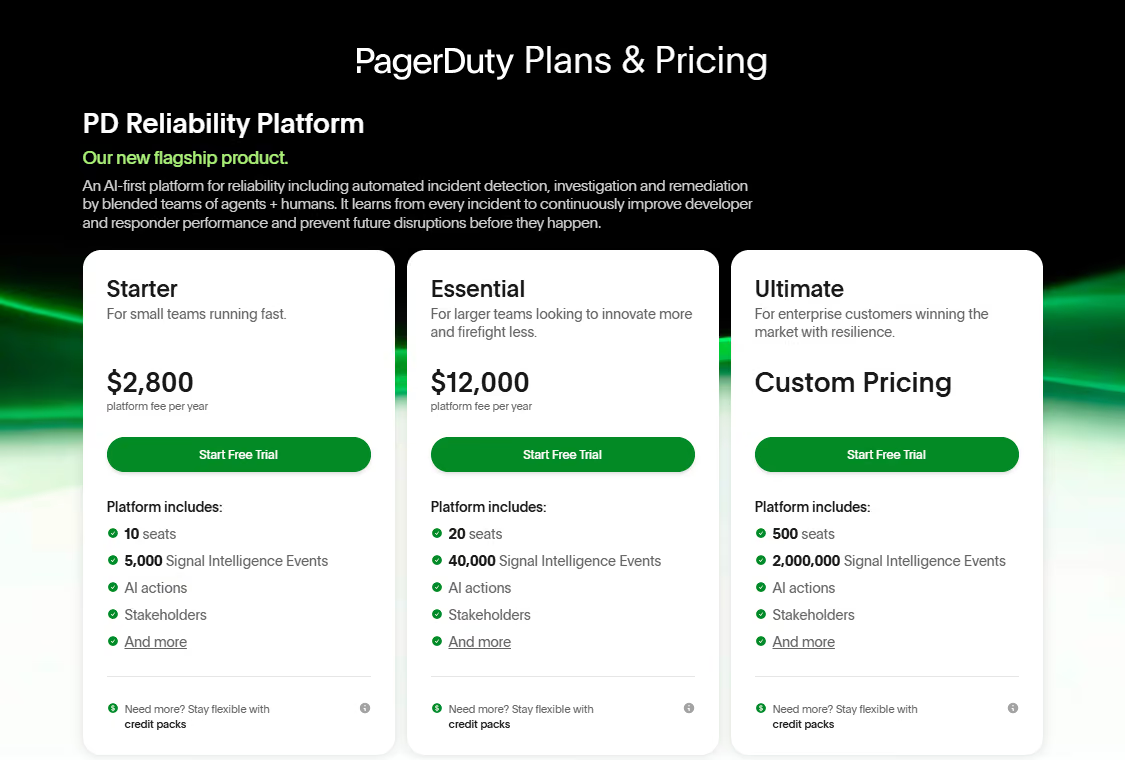
As of October 2026, PagerDuty's pricing page lists:
Plan | Price | Includes |
|---|---|---|
Free | $0 | 5 users, 1 schedule, 1 escalation policy, 100 SMS/phone notifications per month |
Professional | $21/user/month annual, $25 monthly | Unlimited SMS and phone, post-incident reviews, 1 incident workflow; AIOps, AI, Runbook Automation, Status Pages and Live Call Routing are add-ons |
PD Reliability Platform: Starter | $2,800/year | 10 seats, 5,000 events, 1 call-routing line |
PD Reliability Platform: Essential | $12,000/year | 20 seats, 40,000 events, 2 lines |
PD Reliability Platform: Plus | $48,000/year | 50 seats, 150,000 events, 3 lines |
PD Reliability Platform: Ultimate | Custom | 500 seats, 2,000,000 events |
The platform tiers bundle noise reduction, AI agents and advanced workflows, with credit packs for extra seats or events. The older $41 Business plan no longer appears on the public page. For a full breakdown of add-ons and hidden costs, see our PagerDuty pricing guide.
Opsgenie pricing
Opsgenie prices only matter for renewals now. Existing customers can renew and add seats, but cannot change plans, and no term may run past April 5, 2027.
Plan | List price |
|---|---|
Free | $0, up to 5 users |
Essentials | $9.45/user/month; SMS capped, international overages billed |
Standard | $19.95/user/month; unlimited SMS and voice |
Enterprise | Historically up to $31.90/user/month |
Sources: ITOC360 vs Opsgenie (list prices as of September 2026) and incident.io for Enterprise. After migration, you pay Jira Service Management agent pricing instead.
What teams of 10, 20, 50 and 250 pay per year
At list price, ITOC360 and Opsgenie Standard are the cheapest options at every team size, but only one of them will still exist after April 2027.
Option (annual billing) | 10 users | 20 users | 50 users | 250 users | Not included at this price |
|---|---|---|---|---|---|
PagerDuty Professional ($21) | $2,520 | $5,040 | $12,600 | $63,000 | Alert grouping (AIOps), AI, round robin, advanced ITSM integrations |
PagerDuty Reliability Platform | $2,800 (Starter) | $12,000 (Essential) | $48,000 (Plus) | Custom (Ultimate) | Seats and events beyond the tier need credit packs |
Opsgenie Standard ($19.95, renewal only) | $2,394 | $4,788 | $11,970 | $59,850 | Ends April 5, 2027 |
Jira Service Management Premium (est. $47–53) | $5,640–6,360 | $11,280–12,720 | $28,200–31,800 | Volume pricing; get a quote | Third-party estimate; not a published price |
ITOC360 Advanced ($18) | $2,160 | $4,320 | $10,800 | $54,000 | - |
List prices before taxes and discounts. JSM figures use a flat third-party per-agent estimate from incident.io and will differ with volume tiers.
The cheapest line is not the whole story. A team with noisy monitoring on PagerDuty Professional will usually need AIOps, and a team that needs voice calls in JSM must buy Premium.
PagerDuty vs Opsgenie based on reviews
User feedback has been consistent for years. Engineers praise Opsgenie for its schedule view and price, and PagerDuty for reliability, its mobile app and depth. Complaints mirror that: Opsgenie's UI feels dated and Jira-bound, while PagerDuty feels expensive and complex for small teams.
PagerDuty | Opsgenie | |
|---|---|---|
G2 rating | 4.5 | 4.2 |
Most praised | Reliability, mobile app, integrations | On-call schedule view, price, Jira integration |
Most criticized | Price, add-ons, learning curve | Dated UI, forced migration to JSM |
Themes across review sites and comparisons:
Opsgenie's single-screen view of rotations, overrides and the final schedule makes it easy to see who is on call (incident.io).
PagerDuty is widely seen as stronger on incident lifecycle management, Opsgenie on scheduling (OnPage).
Teams moving from Opsgenie to JSM report that simple setups take weeks and complex ones with 20+ integrations take months (incident.io).
Small and mid-size teams most often cite PagerDuty's per-user price plus add-ons as the reason they look elsewhere.
Teams that have already left Opsgenie for ITOC360 mention a fast setup and alert correlation that groups dozens of duplicate alerts into one incident; see the reviews on G2.
The alternative to both: ITOC360
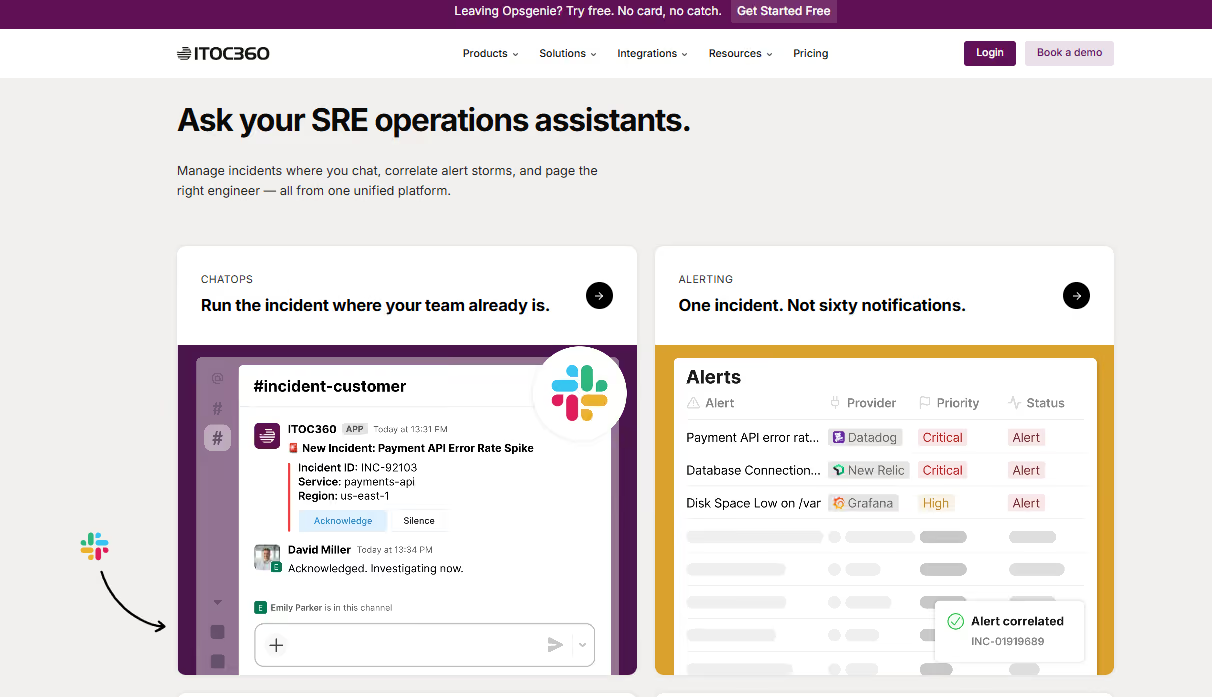
Many teams comparing PagerDuty and Opsgenie in 2026 want what Opsgenie offered, simple alerting and on-call at a fair price, plus the incident response PagerDuty sells as add-ons, without being moved into a service desk or paying PagerDuty's add-on stack. That is the gap ITOC360 is built for: an AI-first incident management platform that runs the whole incident lifecycle in one place, from alert correlation and on-call paging to ChatOps incident response, runbook automation and AI-written retrospectives. We make it, so weigh this section accordingly; every figure below is on our public ITOC360 vs Opsgenie page.
What teams ask for | PagerDuty | Opsgenie / JSM | ITOC360 |
|---|---|---|---|
Voice and SMS on the free plan | 100 notifications per month | Email and push only | Included |
Unlimited SMS and voice | Professional, $21/user | Standard $19.95 (ending); JSM Premium for voice | Advanced, $18/user |
AI alert grouping | AIOps add-on, or platform tiers | JSM Premium and Enterprise | Every plan |
Incoming call routing | Add-on | $10/month per extra number; JSM Premium+ | Included |
Alert and voice languages | Add-on | Limited | 29+ languages, per responder |
API limits | Plan-based | Plan-based | Unlimited API calls on every plan |
Uptime SLA | 99.9% web availability | Ends with the product | 99.99% written SLA on Premium |
What ITOC360 adds:
AI alert correlation. Related alerts from your monitoring tools are grouped into one incident before anyone is paged. One reviewer on G2 described 50 Redis alerts becoming a single ticket.
Automated coverage-gap detection. It finds hours where nobody is actually on call before an alert does.
AI incident retrospectives. The timeline, chat and context are compiled into a write-up when the incident closes.
A no-risk move off Opsgenie. Both tools page in parallel, team by team, and you switch Opsgenie off only when ready. Teams mid-contract can run ITOC360 at no cost until their Opsgenie term ends.
Where ITOC360 is not the best fit: if you need hundreds of niche integrations, a FedRAMP authorization, or deep bidirectional ServiceNow field sync, PagerDuty's enterprise tiers are the safer choice today. The Foundation plan also requires a minimum of three seats.
[Start free, no credit card] · [Book a migration call]
Which is better: Opsgenie or PagerDuty?
It depends on where you start. The table gives the answer for the five situations we see most often.
Your situation | Best choice | Why |
|---|---|---|
New team, never used Opsgenie | PagerDuty (enterprise) or ITOC360 (simplicity and cost) | Opsgenie cannot be purchased. Compare PagerDuty with tools that include noise reduction and voice calls in the base price. |
On Opsgenie, already paying for JSM Premium, Jira-centric | Jira Service Management | The migration is automated and you keep everything in Atlassian. |
On Opsgenie Essentials or Standard, not using JSM | ITOC360 or PagerDuty | Atlassian points you to JSM Standard or Premium, and voice calls need Premium, so the like-for-like cost rises. |
Large enterprise, ServiceNow, hundreds of services | PagerDuty | Integration breadth, ServiceNow sync on Plus and Ultimate, FedRAMP Low and mature automation. |
Small or mid-size team, alert noise is the main problem | ITOC360 | On PagerDuty Professional, alert grouping requires the AIOps add-on. |
Choose PagerDuty if you need enterprise scale, deep automation and AI, and you have the budget for add-ons or a platform subscription.
Stay with Opsgenie, then move to JSM, if your teams live in Jira and you are ready to pay for JSM Premium to keep voice calls, heartbeats and ChatOps.
Choose ITOC360 if you want Opsgenie's simplicity without a forced move into a service desk: alerting, on-call, incident response and ChatOps in one platform, with AI alert correlation, voice and SMS in every plan, at a published per-user price. Teams can run it alongside Opsgenie at no cost until their current contract ends (details).
For a wider shortlist, see the best PagerDuty alternatives and our incident management platforms buyer's guide.
How to migrate off Opsgenie without missing a page
Whichever destination you pick, the safest migration runs both tools in parallel and moves one team at a time. Plan six to ten weeks; teams consistently underestimate the testing phase.
Inventory (week 1). Export schedules, escalation policies, routing rules, integrations, heartbeats and notification policies. Note anything Atlassian marks as deprecated: Incident Command Center, MSP sub-accounts, Groups, global notification policies.
Fix the phone numbers early. If you use incoming call routing with Atlassian-owned numbers, they must be ported manually; Twilio-owned numbers move automatically.
Update automation. Rewrite Terraform for the new provider, update REST API endpoints and replace Opsgenie API keys.
Run in parallel (weeks 2–6). Send every alert to both Opsgenie and the new tool. Compare who was paged, how fast, and through which channel.
Cut over team by team (weeks 6–10). Start with a team with simple rotations. Move the most complex team last.
Switch Opsgenie off. Only after every team has handled real incidents on the new tool for at least two weeks. Export historical data first, because Atlassian deletes unmigrated data on April 5, 2027.
PagerDuty runs a dedicated Opsgenie migration program. ITOC360 maps your schedules and escalation policies for you and stays on the call for your first live rotations (how it works).
Frequently asked questions
Which is better, Opsgenie or PagerDuty?
For new buyers, PagerDuty, because Opsgenie has not been sold since June 4, 2025. For existing Opsgenie users, PagerDuty is better for complex enterprise environments, while Jira Service Management suits Jira-centric teams willing to pay for its Premium plan.
Is Opsgenie being discontinued?
Yes. Atlassian ended Opsgenie sales on June 4, 2025, and will shut the product down on April 5, 2027. On that date access ends and any unmigrated data is deleted.
Can I still buy Opsgenie in 2026?
No. Existing customers can renew and add seats as long as the term ends before April 5, 2027, but they cannot upgrade or downgrade plans.
How much does Opsgenie cost?
Opsgenie list prices are $9.45 per user per month for Essentials and $19.95 for Standard, with a free plan for up to 5 users. These apply to renewals only. After migration you pay Jira Service Management prices.
How much does PagerDuty cost in 2026?
PagerDuty Professional costs $21 per user per month billed annually, or $25 monthly. The PD Reliability Platform starts at $2,800 per year for 10 seats. There is also a free plan for up to 5 users.
Is Jira Service Management the same as Opsgenie?
No. JSM includes Opsgenie's alerting and on-call features, but several of them, including voice notifications, heartbeats and ChatOps incident management, require the Premium or Enterprise plan. Some features, such as the Incident Command Center, are deprecated.
Is Opsgenie cheaper than PagerDuty?
On list price, yes: Opsgenie Standard costs less than PagerDuty Professional and includes unlimited voice and SMS. But Opsgenie is ending, and the recommended JSM plan for Standard customers is Premium, which is usually more expensive than PagerDuty Professional.
What is the best Opsgenie alternative?
It depends on the team. PagerDuty fits large enterprises, JSM fits Atlassian-centric teams, and ITOC360 fits teams that want a full incident management platform, from alert correlation and on-call to incident response and AI retrospectives, at simple per-user pricing. See our list of PagerDuty alternatives for more options.
Is there a better alternative to PagerDuty and Opsgenie?
Yes. ITOC360, an AI-first incident management platform, starts at $12 per user per month, with unlimited SMS and voice from $18, and includes AI alert correlation and incoming call routing in every plan. It also offers a free plan with voice calls and can run alongside Opsgenie at no cost until your contract ends.
Sources
All pages opened and verified on October 7, 2026.