Best Rootly Alternatives in 2026: 7 Tools Compared on Price, Alert Noise and On-Call
Disclosure: ITOC360 is our product. Every claim about Rootly links to Rootly's own pricing page, and we say where another tool is a better fit than ITOC360.
Quick answer: For most IT operations and SRE teams, the best Rootly alternative is ITOC360. It is one AI-first platform for on-call, escalation and incident response, cuts alert noise by around 70% (how we measured it across a million alerts), and charges one per-user price with no on-call add-on and no AI tier.
Why ITOC360 is our top pick over Rootly
Capability | ITOC360 | Rootly |
|---|---|---|
On-call, escalation and incident response | One platform, one price | Two products, $20 + $20 per user |
Alert noise reduction | AI correlation at ingest, every tier (~70% less noise) | Basic grouping; advanced on Enterprise, AI in AI SRE |
AI features | Included at every tier | AI SRE sold separately, price on request |
Paging channels | Phone, SMS, push, email, Slack, Teams | Voice, SMS, push, Slack, Teams |
Entry price with on-call | $12/user/month | $40/user/month |
Pick a different tool if one of these describes you better:
Your bottleneck is coordination in Slack, not alert volume: incident.io is the closest like-for-like swap.
You run years of complex enterprise escalation rules: PagerDuty has the deepest routing, at the highest total cost.
You already pay for Grafana Cloud: Grafana Cloud IRM avoids a new vendor.
You want the cheapest seat and do not need correlation: Squadcast, now part of SolarWinds.
Rootly lists Incident Response and On-Call at $20 per user per month each, so every responder who carries the pager costs $40/month at list price, more than three times ITOC360's entry price. AI SRE, the part that actually reduces alert noise, has no public price at all.
Rootly's weaknesses in 2026: where teams hit the limits
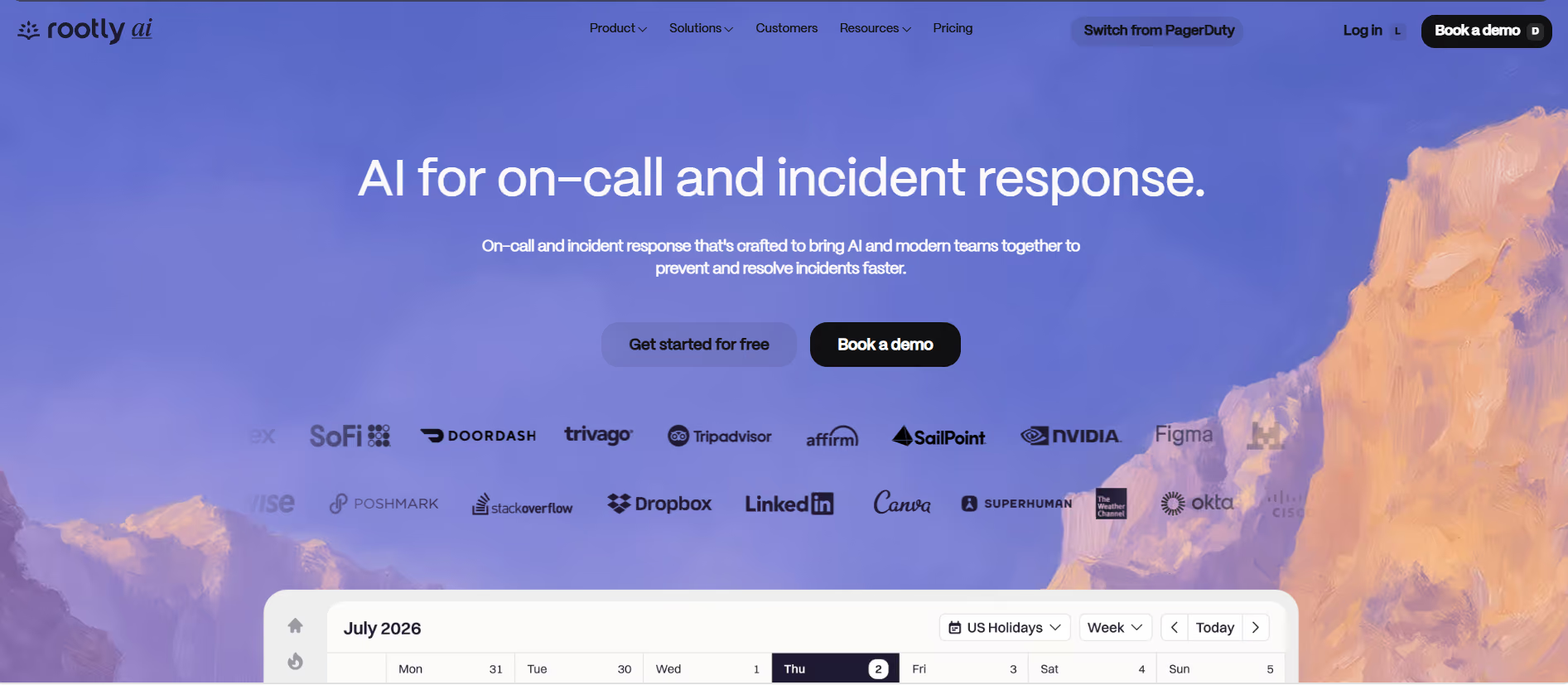
Rootly is a chat-first incident management tool sold as separate products: Incident Response, On-Call, AI SRE and Enterprise. Most of the limits teams run into come from that split. Every point below is taken from Rootly's own pricing page, checked October 15, 2026.
1. Alert noise reduction is gated behind Enterprise and AI SRE
The On-Call product only does "basic" alert grouping. Advanced grouping is listed under Enterprise, and noise suppression with root cause analysis is part of AI SRE, which has no public price and can't be bought without Incident Response. If one outage still pages your team dozens of times, the fix is a sales call, not a plan upgrade.
2. You pay for the pager twice
An on-call responder needs both Incident Response and On-Call: $40 per user per month at list. A 25-person rotation is $12,000 a year before any AI. ITOC360 includes on-call, escalation and AI correlation in one price from $12.
3. Hard limits below Enterprise
On the $20 plans, several limits only lift on Enterprise, which is custom-priced:
Capability | Incident Response + On-Call | Enterprise only |
|---|---|---|
Schedules and escalation policies | 20 | Unlimited |
Live call routing numbers | 1 | 5 |
Alert grouping and noise reduction | Basic | Advanced |
Workflows | Basic | Advanced |
Organizations | 1 | Unlimited |
User provisioning and compliance | SSO + SAML | Adds SCIM and audit logs |
A growing team with several services and regions can hit the 20-schedule limit quickly, and then the price leaves the public page.
4. The parts that fix alert noise have no public price
AI SRE and Enterprise have no list price at all. The products that reduce alert noise and lift the plan limits above can only be priced in a sales call, so you can't calculate Rootly's real cost from its website.
5. The response lives in chat
Rootly's incident workflow is built around Slack, Teams or Google Chat. NOC and IT operations teams that triage from a phone call, a console or a mobile app get less from that model than engineering squads who already live in Slack.
6. No free plan
Rootly offers a two-week trial instead of a free tier. incident.io, PagerDuty and Grafana Cloud IRM all have free entry options for small teams.
These are exactly the gaps ITOC360 was built to close: correlation, escalation and on-call in one AI-first platform, at one published price with no add-ons.
Rootly pricing in 2026: what you actually pay
Rootly costs $40 per user per month at list price for incident response plus on-call, and AI SRE is quoted separately. ITOC360 covers on-call, escalation, incident response and AI alert correlation in one price from $12 per user per month, with no add-ons. Rootly figures are from Rootly's pricing page, checked October 15, 2026.
Rootly product | List price | What it covers |
|---|---|---|
Incident Response | $20/user/month | Slack, Teams and Google Chat response, AI Scribe, retrospectives, workflows, 1 external + 1 internal status page |
On-Call | $20/user/month | Paging by SMS, voice and push, 20 schedules and escalation policies, basic alert grouping |
AI SRE | Quote only | Probable root cause, change correlation, noise suppression, draft fix PRs; requires Incident Response |
Enterprise | Custom | SCIM, audit logs, unlimited schedules, advanced alert grouping, 24/7 priority support |
Three details matter when you budget:
Prices are additive. Rootly states that both products together cost $40 per user per month.
Advanced noise reduction is not in the $40. On the On-Call product, alert grouping is listed as "Basic"; "Advanced" sits on Enterprise, and AI noise suppression is part of AI SRE.
AI SRE and Enterprise have no list price. The two products you would add to fix alert noise or remove plan limits are quoted by sales only.
Rootly vs ITOC360: annual list cost
The table uses published list prices, before discounts. The real gap is wider than it looks: the Rootly columns exclude advanced noise reduction and AI SRE, while every ITOC360 column already includes AI correlation.
Team size | Rootly IR only | Rootly IR + On-Call | ITOC360 Foundation ($12) | ITOC360 Premium ($28) |
|---|---|---|---|---|
10 users | $2,400 | $4,800 | $1,440 | $3,360 |
25 users | $6,000 | $12,000 | $3,600 | $8,400 |
50 users | $12,000 | $24,000 | $7,200 | $16,800 |
With ITOC360, the number on the pricing page is the number on the invoice. AI alert correlation, multi-stage escalation, on-call scheduling and multi-channel paging are included at Foundation, Advanced and Premium alike, with no usage-based AI billing that climbs with alert volume. Small teams can also talk to our team about a small-team discount. See ITOC360 pricing. For the same exercise with PagerDuty, read our PagerDuty pricing breakdown.
Why teams look for Rootly alternatives
Teams rarely switch tools without a trigger. With Rootly, these four come up most often:
The renewal quote arrives. The rotation has grown, both products are billed per responder, and AI SRE or Enterprise has been added to fix alert noise.
The team outgrows the plan. More services and regions push past 20 schedules and escalation policies, and the only next step is a custom Enterprise price.
An alert storm hits during a major outage. Basic grouping lets dozens of related alerts through, and responders spend the first minutes acknowledging pages instead of fixing the cause.
Opsgenie's shutdown forces a fresh evaluation. Atlassian ends Opsgenie support on April 5, 2027. Teams on our Opsgenie end-of-life guide that shortlisted Rootly now compare the total cost before committing.
If trigger 3 is yours, read what we learned processing a million alerts before you compare feature lists.
Rootly alternatives compared at a glance
ITOC360 and Squadcast are the lowest-cost options with on-call included; incident.io is the closest Slack-native match to Rootly. Prices are list, per user per month, checked October 15, 2026.
Tool | Best for | Entry price | On-call included? | Alert correlation | Free option |
|---|---|---|---|---|---|
Rootly (baseline) | Enforced process in Slack, Teams or Google Chat | $20 IR + $20 On-Call | Separate $20 product | Basic; advanced on Enterprise / AI SRE | 2-week trial |
Alert-noise-heavy stacks, NOC and SRE teams | $12 (Foundation) | Yes, every tier | ML correlation, every tier | 14-day trial | |
Slack-native coordination | $15 Team (annual) | Add-on: $10 Team, $20 Pro | Alert grouping | Free up to 5 users | |
Large enterprises, complex routing | $21 Professional (annual) | Yes | AIOps add-on, usage-based | Free plan | |
FireHydrant (Freshworks) | Service catalog and audit trail | Confirm with sales | Yes | Basic | — |
Teams already on Grafana Cloud | $20 per active user + $19 platform fee | Yes | Via Grafana alerting | 3 active users free | |
Budget on-call with SRE extras | $9–$21 by tier (per G2) | Yes | Basic | Free plan |
For scheduling-only comparisons, see our on-call scheduling software guide. For the wider market, see best incident management software in 2026.
The 7 best Rootly alternatives in 2026
Each tool below is judged on the same five questions: who it fits, who it does not, what it costs with on-call, how it handles alert noise, and how it differs from Rootly.
1. ITOC360: one AI-first platform for on-call, escalation and incident response (our product)
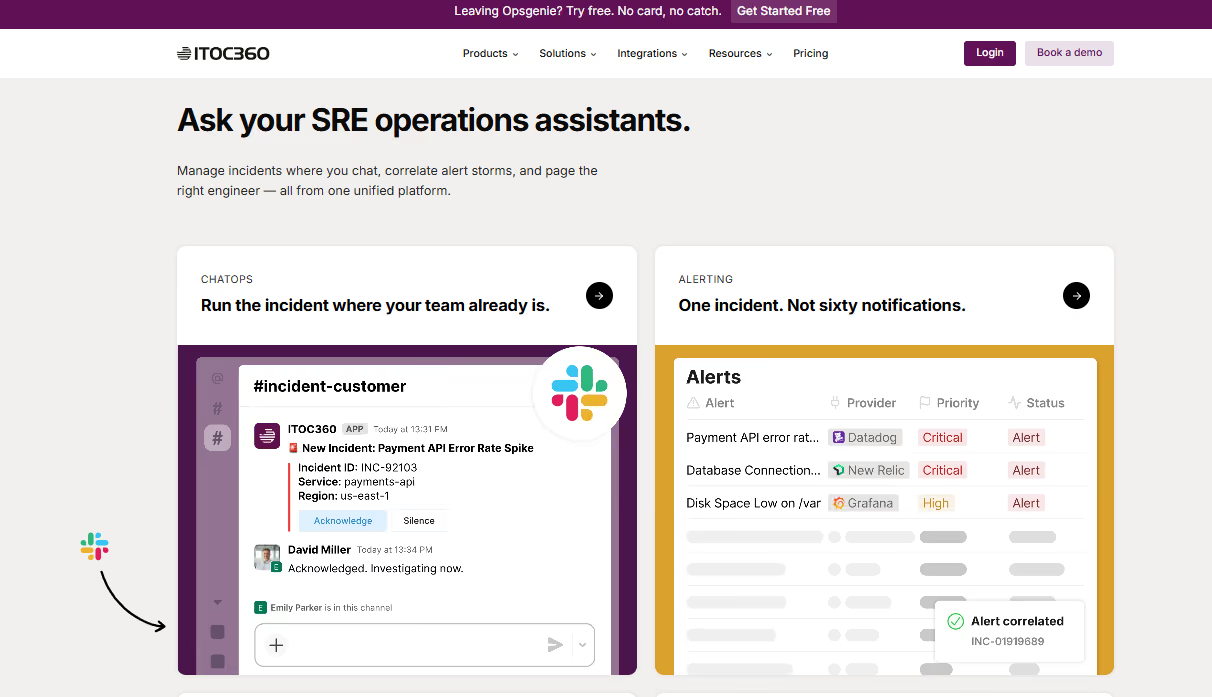
ITOC360 is built for IT operations and SRE teams that can't afford a missed page. It ingests alerts from 50+ sources, correlates related alerts into one incident by label, resource and time proximity, and pages the engineer who owns the service, escalating until someone answers. Teams see around 70% less alert noise, based on our analysis of a million processed alerts, and everything from the first alert to the postmortem stays in one place.
Where it beats Rootly: Alert correlation, escalation and on-call scheduling are in every tier, with no AI tier and no on-call add-on. Rootly gates advanced grouping behind Enterprise and AI SRE.
Paging beyond chat: Pages go out by phone call, SMS, push, email, Slack and Teams, and escalate until someone acknowledges. Responders can acknowledge, silence and escalate from the ITOC360 mobile app.
Migration: Schedules and escalation policies are imported, and a named engineer stays with you through the first week of live rotations.
Pricing: $12 (Foundation), $18 (Advanced) and $28 (Premium) per user per month, published, with every AI feature included. See ITOC360 pricing.
Not the right fit: If you run fewer than five incidents a month from a single monitoring tool, correlation has little to work with and a basic pager is enough.
2. incident.io: best for Slack-native coordination
incident.io is the closest like-for-like replacement for Rootly: both run the incident lifecycle inside Slack and Teams.
Pricing: Per incident.io's pricing page, Team is $15/user/month on annual billing plus $10 for on-call. Pro is $25 plus $20 for on-call, so $45 all-in. Incident management and on-call are free for up to 5 users.
Best for: Engineering teams whose bottleneck is coordination, not alert volume.
Not for: Teams that want on-call without a per-user add-on, or that need deep alert correlation before the incident is declared.
3. PagerDuty: best for complex enterprise paging
PagerDuty has the most mature routing and escalation rules in the category, and the most add-ons.
Pricing: Professional is $21/user/month on annual billing, per PagerDuty's pricing page. Business is commonly listed at $41. AIOps (noise reduction) is a separate, usage-based add-on, and AI features in PagerDuty Advance are credit-based.
Best for: Large organizations with years of escalation policies already built in PagerDuty.
Not for: Teams leaving Rootly to cut cost; once AIOps is added, PagerDuty is usually the most expensive option here. Full math in our PagerDuty pricing breakdown and PagerDuty alternatives list.
4. FireHydrant: best for service catalog and audit trails
FireHydrant is now part of Freshworks: the acquisition closed on January 5, 2026, folding it into the Freshservice portfolio.
Best for: Organizations where ownership mapping and compliance records matter more than speed of setup.
Not for: Small teams without someone to maintain the service catalog.
Watch out: Pricing and packaging often change after an acquisition, so confirm current terms with sales. See our FireHydrant alternative guide.
5. Grafana Cloud IRM: best if you already run Grafana Cloud
Grafana Cloud IRM is the maintained successor to Grafana OnCall, whose open-source edition was archived in March 2026.
Pricing: Up to 3 active IRM users are free; beyond that it is $20 per active user plus the $19 Grafana Cloud Pro platform fee.
Hidden cost: Per Grafana's billing docs, being listed in a schedule or escalation chain makes a user billable for the month, even with zero pages.
Not for: Teams whose monitoring is not Grafana-centric; it adds a second observability bill.
6. Squadcast (SolarWinds): best budget option
SolarWinds acquired Squadcast in 2025, and it is now sold as SolarWinds IT Incident Response.
Pricing: G2 lists three editions from $9 to $21 per user per month, with a free trial.
Best for: Teams whose process already works and who mainly want cheaper on-call.
Not for: Teams that need strong alert correlation; grouping is basic.
7. Jira Service Management: best for Atlassian-committed IT teams
Atlassian is folding Opsgenie's on-call and alerting into Jira Service Management ahead of the April 5, 2027 end of support.
Best for: IT teams whose incidents must link to change and problem records in Jira.
Not for: Engineering teams who want chat-first response or AI correlation; JSM is ticket-first.
Next step: Our Opsgenie alternative guide compares JSM with the other migration paths.
Leaving Opsgenie: Rootly vs PagerDuty vs ITOC360
If you are replacing Opsgenie, pick by how your team works when a page fires, not by feature count. Opsgenie support ends on April 5, 2027, so plan a parallel run of at least two to four weeks before that date.
Your situation | Best fit | Why |
|---|---|---|
One outage triggers dozens of alerts; NOC or IT ops pages by phone and SMS | ITOC360 | Correlation, escalation and on-call included at every tier, from $12/user |
Responders coordinate only in Slack and alerts are already clean | incident.io or Rootly | Chat-first; expect $40–45/user with on-call, plus AI pricing on request |
Years of complex escalation rules, budget is secondary | PagerDuty | Deepest routing; AIOps and status pages are add-ons |
Incidents must live next to Jira change and problem records | Jira Service Management | Atlassian's own landing point for Opsgenie features |
The ITOC360 Opsgenie migration page shows how schedules and escalation policies move across.
How to migrate from Rootly in 4 weeks
A safe Rootly migration runs both tools in parallel until real incidents prove that no page is missed. For a 10–50 person rotation, four weeks is a realistic plan.
Week 1 — Inventory and export. List every alert source, schedule, escalation policy and workflow in Rootly. Export incident history and retrospectives through the Rootly API so audit evidence survives the switch.
Week 2 — Connect and mirror. Point your monitoring tools (Prometheus, Datadog, Grafana, CloudWatch) at the new platform as a second destination. Recreate schedules and escalation policies; on ITOC360 this import is done with you.
Week 3 — Parallel run. Page through both tools. Compare time to acknowledge, number of pages per incident and missed escalations. Check our guide to on-call management for what to measure.
Week 4 — Cut over. Move primary paging to the new tool, keep Rootly read-only for 30 days, then cancel at renewal.
Before week 1, check your Rootly contract end date. Annual contracts make the renewal date your real deadline.
Frequently asked questions
What are the best alternatives to Rootly?
The strongest Rootly alternatives in 2026 are ITOC360, incident.io, PagerDuty, FireHydrant, Grafana Cloud IRM, Squadcast and Jira Service Management. ITOC360 fits teams fighting alert noise, incident.io fits Slack-first coordination, and PagerDuty fits large enterprises with complex routing.
How much does Rootly cost in 2026?
Rootly lists Incident Response at $20 per user per month and On-Call at $20 per user per month, so both together cost $40 per user per month. AI SRE and Enterprise are quoted by sales. Status pages are included with Incident Response.
Does Rootly have startup pricing?
Yes. Rootly advertises up to 50% off for startups under 100 employees. ITOC360 also offers small-team discounts through our team. The difference is the starting point: every ITOC360 feature, including AI correlation, has a published list price, while Rootly's AI SRE and Enterprise have none.
Is Rootly cheaper than PagerDuty?
At list price, Rootly with on-call ($40/user/month) costs more per seat than PagerDuty Professional ($21) and about the same as PagerDuty Business. PagerDuty's total rises once AIOps, status pages and other add-ons are counted.
What is the cheapest Rootly alternative with on-call included?
Among the tools here, ITOC360 Foundation ($12/user/month) is the lowest published list price that includes on-call, escalation and AI alert correlation, and small teams can ask about an additional discount. Squadcast's entry edition is similarly priced but without correlation. incident.io and Grafana Cloud IRM are free for very small teams (5 and 3 users).
Which Rootly alternative is best for Opsgenie users?
It depends on where your team responds. Chat-first teams usually pick Rootly or incident.io, Atlassian-centric IT teams pick Jira Service Management, and teams with heavy alert volume or phone/SMS paging pick ITOC360.
Can I migrate from Rootly without downtime?
Yes, if you run both tools in parallel. Send alerts to both, page through both for one to two weeks, then move primary paging and keep Rootly read-only for 30 days.
How we evaluated these tools, and sources
We scored each tool on alert correlation, on-call depth, paging channels, pricing transparency and fit for Rootly's typical buyer. Prices are list prices from each vendor's public page, checked October 15, 2026; negotiated and discounted prices will differ. We will re-check this page in January 2027. Spot something out of date? Tell us.
incident.io — Pricing
PagerDuty — Plans and pricing
Grafana Labs — IRM billing documentation and Grafana OnCall OSS maintenance notice
Atlassian — Opsgenie licensing and end of support
Freshworks — FireHydrant acquisition announcement
Squadcast — SolarWinds acquisition notice and G2 pricing editions
ITOC360 — Pricing and mobile app listing
Related reading on ITOC360: Best incident management software 2026 · Opsgenie alternatives · PagerDuty pricing 2026 · FireHydrant alternative · Best on-call scheduling software