FireHydrant Alternative: What Changed After the Freshworks Acquisition
Quick answer: FireHydrant is no longer an independent company — Freshworks acquired it in a deal that closed Q1 2026, and by May 2026 folded it into Freshservice as an ITOM layer. If you chose FireHydrant specifically to stay independent of a service-desk suite, the strongest standalone alternatives in 2026 are ITOC360 (AI-native, not tied to an ITSM roadmap), PagerDuty (the established enterprise incumbent), incident.io (Slack/Teams-native coordination), and Rootly (opinionated workflow automation). If you actually want incident management bundled with a full ITSM suite, staying on FireHydrant/Freshservice may still be right for you.
Key facts:
FireHydrant was acquired by Freshworks for a disclosed $88.7 million, deal closed Q1 2026.
FireHydrant is now integrated into Freshservice as its IT Operations Management (ITOM) layer, not sold as a standalone product.
The strongest standalone alternatives in 2026 are ITOC360, PagerDuty, incident.io, and Rootly.
What Actually Happened, in Order
FireHydrant's acquisition by Freshworks follows a pattern teams have seen before with Opsgenie and Atlassian: an independent incident response tool gets absorbed into a larger ITSM platform's roadmap.
Date | Event |
|---|---|
December 2025 | Freshworks announces a definitive agreement to acquire FireHydrant |
Q1 2026 | Deal closes; Freshworks' Q1 2026 earnings disclose an $88.7M purchase price and $52.6M in goodwill |
May 2026 | At Freshworks' "Refresh 2026" event, FireHydrant's incident response and on-call capabilities are formally integrated into Freshservice's ITOM functionality |
May 2026 | Freshworks separately announces an 11% headcount reduction and $7–9M in restructuring charges |
None of this means FireHydrant stopped working or that Freshworks is mismanaging the product — Freshservice is a large, established platform and the integration has shipped real features (a Freshservice-FireHydrant connector is live in the Freshworks Marketplace). The point is narrower: the product you evaluated FireHydrant as in 2024 is not the product you're buying in 2026. It's now positioned as an extension of Freshservice's ITSM suite, with a roadmap set by Freshservice priorities, not an independent incident-response roadmap.
FireHydrant Today: Features and Pricing
FireHydrant's core feature set hasn't disappeared post-acquisition — incident analytics, on-call and alerting, runbooks, and incident retrospectives remain the product's backbone, now sold alongside Freshservice's ITSM capabilities rather than as a fully independent platform.
Pricing has historically run on annual licensing rather than the monthly per-seat model most competitors use: full-platform licensing and incident-management-only tiers have both been reported in the $6,000–$9,600/year range, with on-call priced separately based on responder count.
Whatever you choose next, track the switch against real numbers rather than gut feel — our incident management KPIs guide covers the metrics worth benchmarking before and after a migration.
Why Teams Are Re-Evaluating Now
Roadmap ownership shifted. Product direction is now set within Freshservice's broader ITOM strategy, not FireHydrant's original engineering-first vision.
You may be paying for a bundle you didn't want. Teams that chose FireHydrant specifically to avoid a full ITSM suite are now, structurally, evaluating a tool that's positioned as part of one.
Restructuring creates reasonable uncertainty. An 11% company-wide headcount reduction in the same quarter as a major acquisition integration is a legitimate signal to ask questions about continuity of support and feature velocity — not a reason to panic, but a reason to ask.
Renewal timing. If your contract is coming up, this is a natural checkpoint to compare rather than auto-renew. See our broader PagerDuty alternatives comparison if you're evaluating more than just FireHydrant's replacement.
You're not the only one dealing with this. FireHydrant is the third notable tool in this category absorbed by a larger platform in roughly 18 months: Opsgenie into Atlassian, Squadcast into SolarWinds (March 2025), and now FireHydrant into Freshworks. If vendor independence matters to your evaluation, it's worth checking that criterion explicitly against whichever alternative you're considering next — not just against FireHydrant.
FireHydrant Alternatives, by Category
Teams evaluating FireHydrant alternatives in 2026 generally fall into three groups, and the right pick depends on which one you're in.
Direct workflow-layer competitors — same shape of product as FireHydrant: structured incident lifecycle, runbook automation, ChatOps, service catalog. ITOC360, Rootly, and incident.io sit here.
Routing-first incumbents — lead with alert routing, on-call scheduling, and escalation depth, with workflow features layered on top rather than at the core. PagerDuty and xMatters sit here.
Lighter / bundled alternatives — trade feature depth for a smaller-team price point or a single bundled SKU covering more than just incident response. Squadcast, Better Stack, and BigPanda sit here.
FireHydrant alternatives at a glance
Tool | Category | Best for |
|---|---|---|
ITOC360 | Workflow layer (direct competitor) | Teams that want AI-native alert correlation without inheriting a service-desk roadmap |
Rootly | Workflow layer (direct competitor) | Teams standardizing entirely in Slack/Teams who want opinionated automation and retrospectives |
incident.io | Workflow layer (direct competitor) | Teams prioritizing polished in-incident coordination over deep runbook automation |
PagerDuty | Routing-first incumbent | Large enterprises whose primary pain is escalation depth and integration breadth, not workflow |
xMatters | Routing-first incumbent | Teams wanting a simpler, reliability-focused router without heavy customization overhead |
Squadcast | Lighter / bundled (now part of SolarWinds) | Smaller DevOps/SRE teams that want workflow plus on-call plus SLO tracking at a fraction of the price |
Better Stack | Lighter / bundled | Teams that want incident response bundled with uptime and log monitoring in one SKU |
BigPanda | Lighter / bundled (AIOps-leaning) | Teams whose primary pain is alert correlation and noise reduction, not incident coordination itself |
ITOC360
Workflow layer (direct competitor)
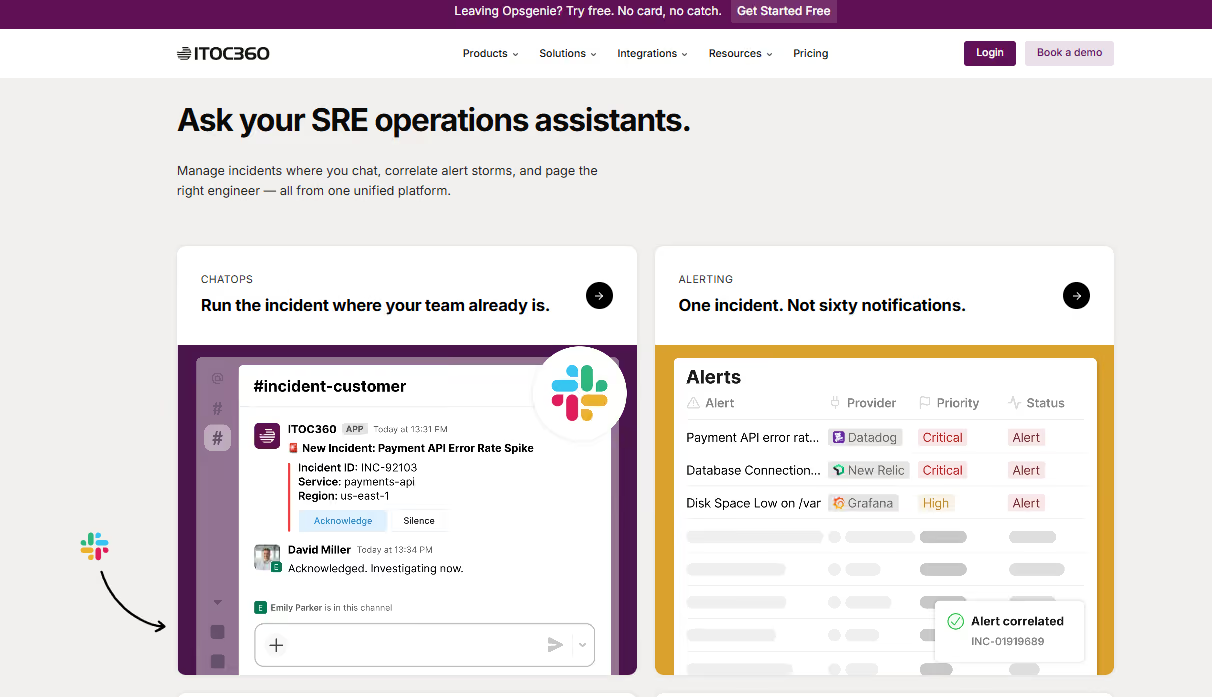
AI-native alert correlation and escalation orchestration, standalone and not tied to an ITSM roadmap.
The core argument for switching to ITOC360 specifically — not just any alternative — is independence from a roadmap you don't control. ITOC360 is built AI-first for the incident response and on-call layer specifically; it isn't a module inside a larger service-desk product, so its roadmap isn't competing for priority against ticketing, asset management, or other ITSM features the way FireHydrant's now does. See our best incident management platform for SRE teams guide for what SRE-first design means in practice.
Good at:
AI-native alert correlation and escalation routing, not a bolted-on add-on tier.
Staying independent of a service-desk suite's competing roadmap priorities.
Transparent, published per-seat pricing.
Less suited for: Teams that specifically want the broader ITSM/service-desk functionality Freshservice now bundles — that's a genuine trade-off, not a gap to paper over. Also worth weighing: a smaller integration ecosystem and fewer large-enterprise reference customers than PagerDuty.
Rootly
Workflow layer (direct competitor)
Slack/Teams-native incident management with opinionated workflow automation and AI-assisted retrospectives.
Rootly is the closest direct competitor in ergonomics to FireHydrant's Slack/Teams-native ChatOps, but more opinionated about enforcing a consistent incident process rather than leaving structure up to the responder.
Good at: Automated postmortems generated from the response timeline; strong Slack/Teams-first declaration and role assignment; AI-assisted root cause hints from connected CI/CD sources.
Less suited for: Teams whose incidents commonly trace back to out-of-band infrastructure changes (manual IAM edits, kubectl changes) that don't flow through CI/CD — Rootly's change-awareness is CI/CD-derived, not infrastructure-graph-derived.
incident.io
Workflow layer (direct competitor)
Polished Slack/Teams-native coordination with Catalog-driven ownership routing.
Good at: In-incident coordination and communication; Catalog-based ownership context; a 2025 AI layer for summarizing context and drafting postmortems.
Less suited for: Teams that want deep runbook automation with structured rollback paths — that's closer to FireHydrant's and Rootly's strength than incident.io's. See our dedicated incident.io alternative guide if this is your primary evaluation.
PagerDuty
Routing-first incumbent
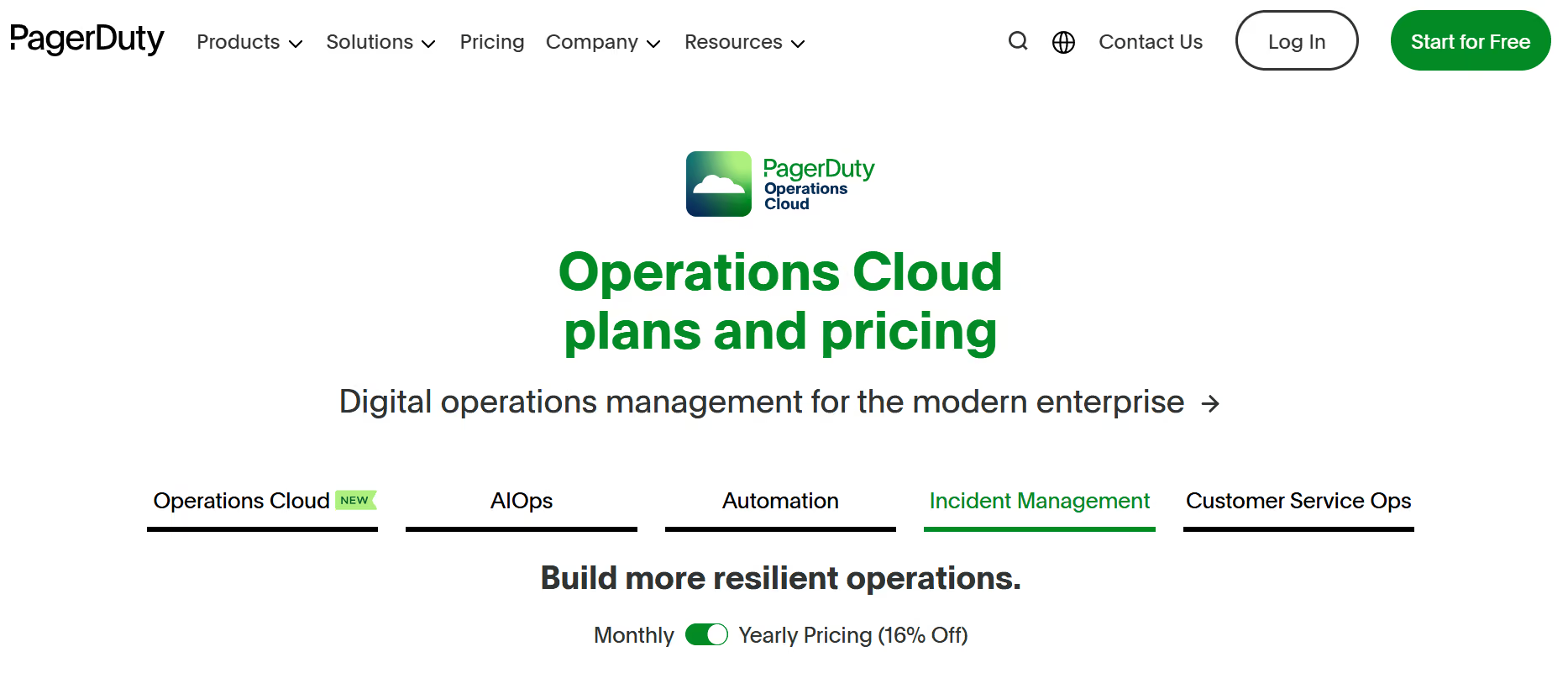
Enterprise-standard alert routing, on-call scheduling, and escalation policies, with workflow layered on top.
Good at: Escalation depth and a large third-party integration footprint; enterprise compliance posture and audit trail maturity.
Less suited for: Teams whose entire incident lifecycle is meant to run inside chat — PagerDuty's workflow surface is shallower than the Slack/Teams-native competitors on this list, and its per-seat cost scales in ways that don't always track the value delivered for smaller rotations.
xMatters
Routing-first incumbent
Simpler, reliability-focused alerting and escalation without heavy customization.
Good at: Straightforward on-call scheduling, escalations, and multi-channel alerting for teams that found FireHydrant's feature surface bigger than they needed.
Less suited for: Teams wanting deep workflow automation or service-catalog modeling — xMatters trades sophistication for simplicity by design.
Squadcast
Lighter / bundled (lower price point)
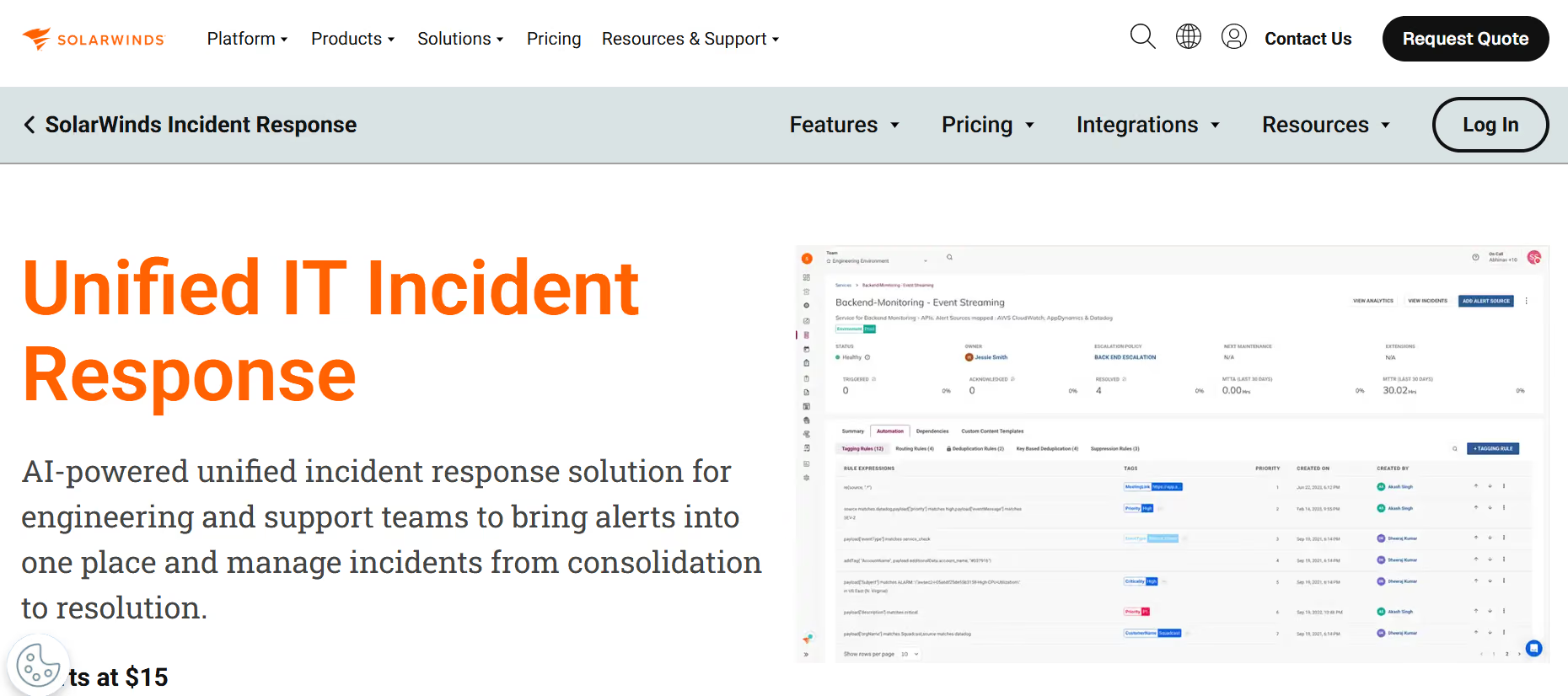
Workflow plus on-call plus SLO tracking, bundled at a smaller-team price point — but also no longer an independent company.
SolarWinds acquired Squadcast in March 2025, folding it into its observability and IT management portfolio. That makes Squadcast the third tool in this space to lose its independence in roughly the same window as FireHydrant: Opsgenie into Atlassian, Squadcast into SolarWinds, FireHydrant into Freshworks. If staying independent of a larger platform's roadmap is part of your evaluation, Squadcast carries the same caveat this guide raises about FireHydrant.
Good at: Bundling incident response, on-call scheduling, and SLO tracking with built-in status pages at a lower per-seat cost than the workflow-layer incumbents. See our SLA vs SLO vs SLI guide if SLO tracking is the deciding feature for your team.
Less suited for: Teams specifically prioritizing vendor independence — Squadcast is now subject to SolarWinds' broader observability roadmap the same way FireHydrant is now subject to Freshservice's. Also a consideration for enterprise teams with complex escalation hierarchies or deep service-catalog modeling needs, where the feature surface is narrower than FireHydrant's or ITOC360's by design.
Better Stack
Lighter / bundled
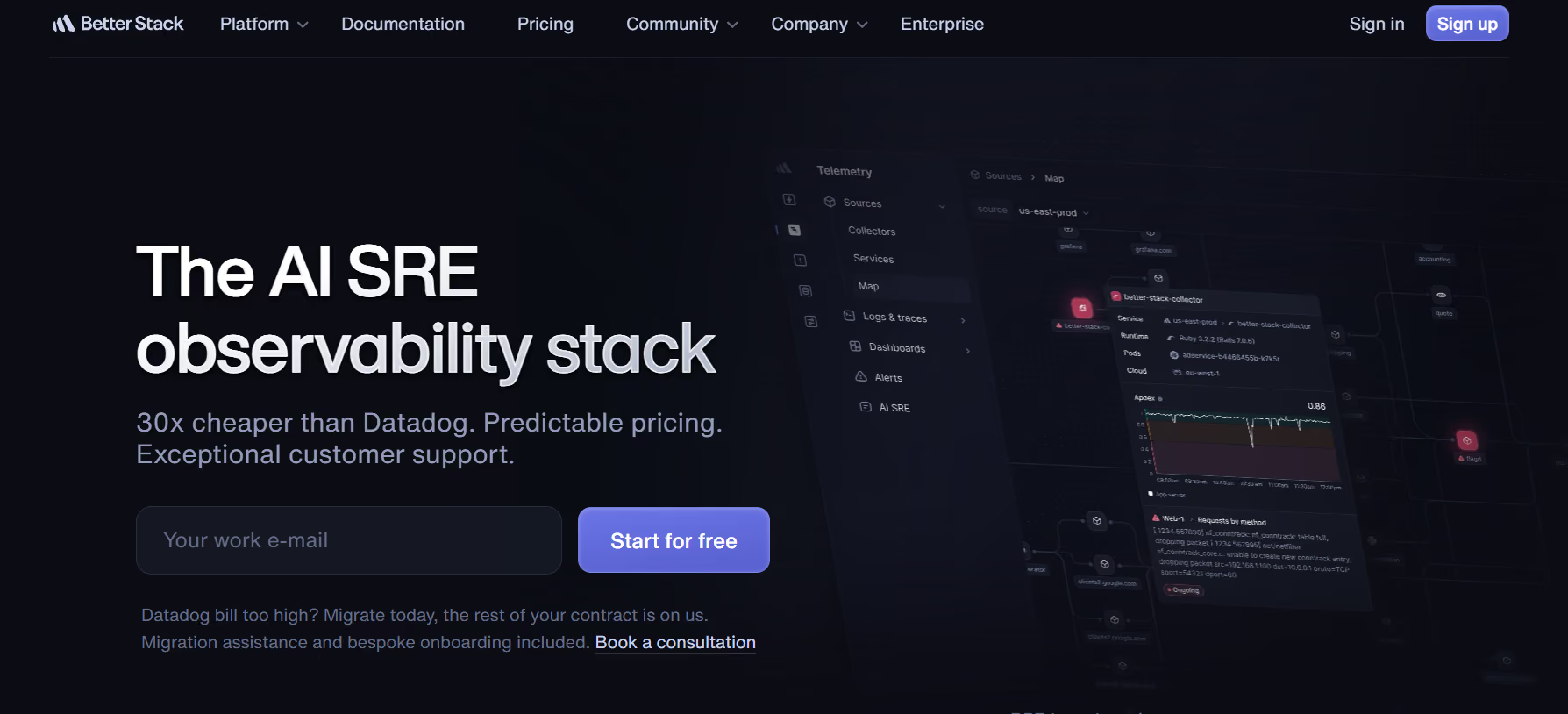
Incident response bundled with uptime monitoring, log management, and status pages in one SKU.
Good at: Consolidating incident management, uptime monitoring, and status pages into a single product for teams that would otherwise stitch three tools together.
Less suited for: Teams whose primary need is structured incident lifecycle or service-catalog modeling — Better Stack leads with monitoring and routing, not deep workflow.
BigPanda
Lighter / bundled (AIOps-leaning)
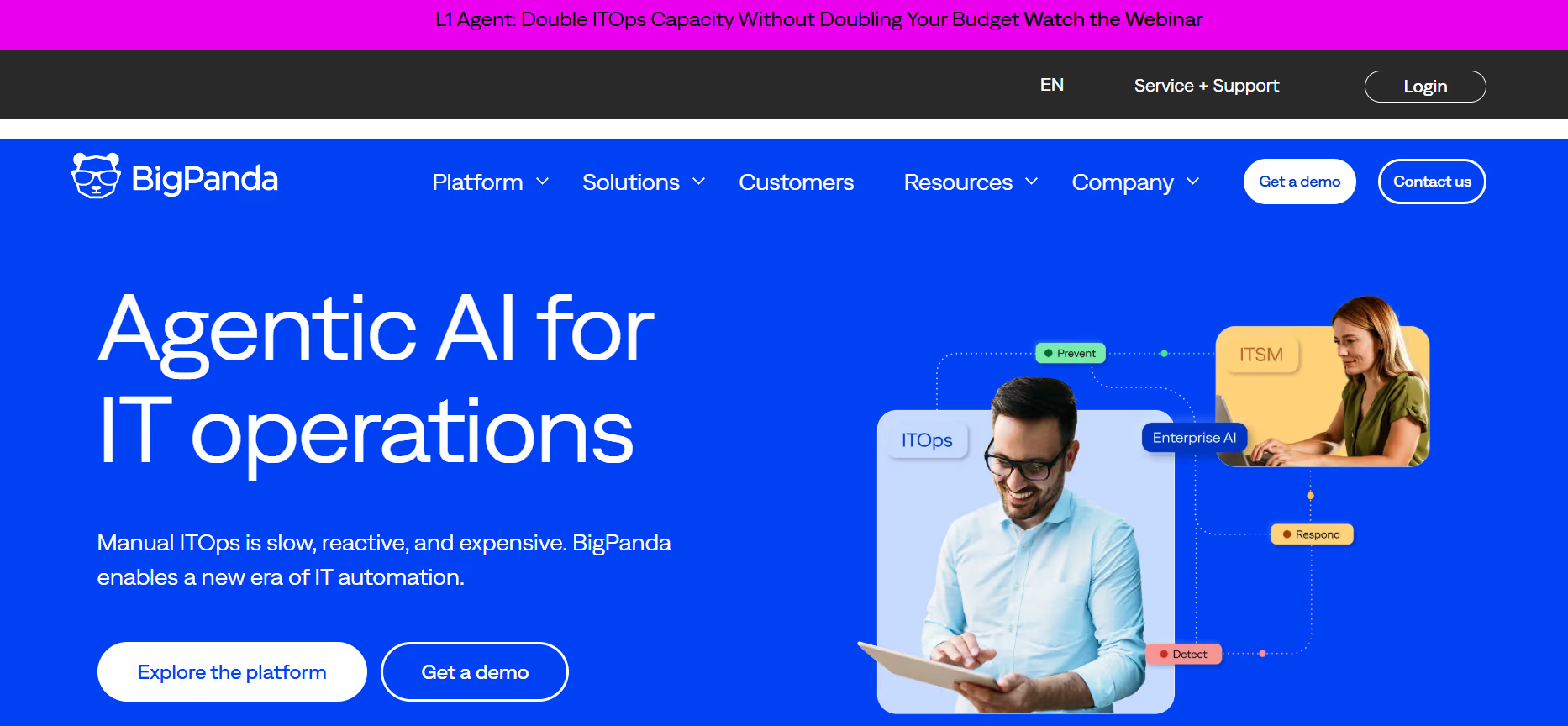
Alert correlation and noise reduction, closer to AIOps than incident coordination.
Good at: Correlating alerts from multiple monitoring sources to cut noise before an incident is even declared.
Less suited for: Teams whose primary pain is retrospectives, runbook execution, or structured post-incident process — BigPanda's strength is upstream of that, in correlation.
Detailed Feature Comparison
Feature | ITOC360 | Rootly | incident.io | PagerDuty | Squadcast |
|---|---|---|---|---|---|
Primary bucket | Workflow | Workflow | Workflow | Routing + workflow | Workflow + on-call |
AI triage/correlation | Yes, built-in | Yes (AI SRE) | Yes | Paid add-on (AIOps) | Limited |
Service catalog | Yes | Yes | Yes (Catalog) | Service directory | Basic services |
Standalone (not ITSM-bundled) | Yes | Yes | Yes | Yes | Yes |
Approx. pricing | Published per-seat | Custom, sales-led | From $15/user/mo + on-call add-on | From ~$21/user/mo | From ~$9–16/user/mo (sources vary) |
Pricing, certifications, and feature specifics are approximate as of publication and pulled from public sources that don't always agree with each other — confirm current details directly with each vendor before budgeting.
Which Alternative Fits Your Team
We want AI-native alert correlation without inheriting a service-desk roadmap → ITOC360
We want a direct Slack/Teams-native workflow competitor with similar shape to FireHydrant → Rootly or incident.io
Our routing and escalation depth is the priority, workflow is secondary → PagerDuty or xMatters
We need workflow plus on-call at a smaller-team price → Squadcast
We want one bundled tool for incident response plus uptime/log monitoring → Better Stack
Our blocking problem is alert noise, not incident coordination → BigPanda
We already run Freshservice and want ITSM plus incident management in one bundle → staying on FireHydrant/Freshservice may still be right — see the FAQ below.
Migrating From FireHydrant: What to Check First
Runbooks and automation rules. FireHydrant's automation engine is a core feature — confirm your target platform can replicate the same trigger logic, not just the alert routing. See our automated incident management guide for what full-lifecycle automation should actually cover.
Service catalog dependencies. If you've mapped services and ownership in FireHydrant, check what exports cleanly and what needs to be rebuilt.
Status page continuity. If FireHydrant hosts your customer-facing status page, plan the cutover separately from the incident-response migration so you don't have a gap in public communication.
Contract timing. Since FireHydrant is now billed and supported through Freshworks, check your renewal terms specifically — they may have changed since the acquisition closed.
On-call schedules and escalation policies. Rebuild these first, before integrations — see our on-call management guide for the full sequencing.
For general migration sequencing (schedules and escalation policies first, integrations second), see our incident response lifecycle guide.
When Staying on FireHydrant/Freshservice Is Still the Right Call
Staying is the right choice when your organization already runs Freshservice as its ITSM system of record and wants incident management genuinely unified with ticketing, asset management, and service requests rather than stitched together via integration. Freshservice customers get a real ITOM layer out of this acquisition, not a downgrade — the connector is live, and the roadmap direction (deeper Freshservice integration) is a stated priority, not an afterthought.
The re-evaluation in this guide is aimed at a narrower group: teams that chose FireHydrant specifically because it was independent of a service-desk suite, and now find themselves structurally inside one. If that's not your situation — if you were already planning to consolidate onto Freshservice, or don't mind incident management living inside a broader ITSM roadmap — this acquisition is a reasonable upgrade, not a reason to migrate.
Frequently Asked Questions
Is FireHydrant still a standalone product? No. As of May 2026, FireHydrant's incident response and on-call capabilities are integrated into Freshservice as its IT Operations Management (ITOM) layer, following Freshworks' acquisition of FireHydrant, which closed in Q1 2026 for a disclosed $88.7 million.
Does FireHydrant still work the same way for existing customers? At the time of the acquisition, Freshworks stated that existing FireHydrant accounts, pricing, and support would stay the same in the near term, with deeper integration into Freshservice planned afterward. Confirm current terms directly with Freshworks/FireHydrant, since integration timelines move.
What's the best FireHydrant alternative if I want to stay independent of an ITSM suite? ITOC360, PagerDuty, incident.io, and Rootly are the strongest standalone options — each purpose-built for incident response and on-call rather than positioned as a module inside a larger service-desk platform.
Should I switch just because of the acquisition? Not necessarily. If your organization already runs Freshservice and wants incident management bundled with your ITSM suite, the integration may be a genuine upgrade. The re-evaluation is most relevant for teams that specifically chose FireHydrant to avoid an ITSM bundle in the first place.
Sources
Freshworks Q1 2026 earnings / 10-Q filing — purchase price and restructuring disclosure
Constellation Research analysis of Freshworks Refresh 2026 — FireHydrant/Freshservice integration details
SolarWinds press release: Squadcast acquisition — March 2025, cited for the broader consolidation-trend framing
Also see our related guides: what happened with Opsgenie's end-of-life (the same consolidation pattern, one cycle earlier), our incident.io alternative guide if you're comparing more than one platform, and our enterprise incident management software guide if compliance and multi-team scale are part of your evaluation.
Evaluating a move off FireHydrant? Try ITOC360 free or see our full incident management platform overview.