What Is Site Reliability Engineering (SRE)? The Complete 2026 Guide
62% of site reliability engineers report weekly sleep disruption from night pages. That number comes from a survey of over 30,000 IT professionals — and it reveals the core tension in every SRE practice: the discipline exists to make systems reliable, but the humans running those systems are often anything but.
Site reliability engineering (SRE) is the software engineering approach to solving that problem. It replaces reactive firefighting with measurement, automation, and deliberate design — so teams spend less time being woken up at 3 AM and more time building systems that don't need them to be.
This guide covers what site reliability engineering is, how it works, what separates it from DevOps, who becomes an SRE, and how to implement it in your organisation in 2026.
What you'll learn:
The one-sentence definition of SRE, and the five core principles from Google's foundational book
How SLAs, SLOs, error budgets, and the four golden signals work in practice
The concrete benefits SRE delivers, and where SRE and DevOps overlap or diverge
Who becomes a site reliability engineer, and what the "50-50 rule" means in practice
The on-call benchmarks that separate high-performing SRE teams from the rest
A four-stage roadmap for building SRE practices from scratch, including chaos engineering and capacity planning
What Is Site Reliability Engineering?
Site reliability engineering (SRE) is the practice of applying software engineering to IT operations so that production systems stay reliable, scalable, and automated.
That's the discipline in one sentence. Everything else in this guide explains how teams put it into practice.
Ben Treynor Sloss coined the term at Google in 2003. His own definition remains the clearest: "SRE is what you get when you treat operations as a software problem." Instead of assigning system administrators to keep services running by hand, Google gave the job to software engineers and asked them to solve reliability the way they'd solve any other engineering problem — with code, measurement, and automation.
The discipline gained industry traction after Google published its SRE book in 2016 — available free at sre.google. Since then, adoption has accelerated sharply. Gartner projects that 75% of enterprises will use SRE practices by 2027, up from just 10% in 2022.
SRE sits at the intersection of software development and IT operations. Where traditional ops teams react to outages, SRE teams engineer systems to prevent them — and respond faster when prevention isn't enough.
How SRE Works: The Three Core Loops
SRE operates through three interlocking loops that connect measurement to action.
Measure — Define what reliability means for each service using service level indicators (SLIs): the raw signals of performance from a user's perspective. Common SLIs include request success rate, latency at the 99th percentile, and availability.
Own — Set service level objectives (SLOs) as internal reliability targets, then derive an error budget from the gap between the SLO and 100% uptime. A 99.9% availability SLO means 0.1% — roughly 43 minutes per month of downtime — is the permitted failure envelope.
Improve — When the error budget is healthy, teams ship features. When it burns down fast, reliability work takes priority over new functionality. This creates a data-driven contract between engineering and product that neither side can unilaterally override.
Metric | What it measures | Example |
|---|---|---|
SLA | Contractual reliability promise to a customer | 99.95% uptime, penalties apply below that |
SLI | Raw reliability signal | Request success rate |
SLO | Internal reliability target | 99.9% success rate / 30 days |
Error budget | Permitted unreliability | 0.1% = ~43 min/month |
Mean time to acknowledge | < 5 min for P1 incidents | |
Mean time to resolve | < 30 min for P1 incidents |
What is an SLA in SRE terms? A service level agreement (SLA) is the external, contractual promise a company makes to its customers — for example, "99.95% uptime, or you get a service credit." It's set by the business and legal teams, not by SRE. The SLO is always set tighter than the SLA, so the team has room to notice and fix problems before a contractual breach happens. SLAs are contractual and external; SLOs are internal targets; SLIs are the raw measurements that feed both — for the full breakdown of how the three layers work together, see our SLA vs SLO vs SLI guide.
The Five SRE Principles
Google's SRE book organises the discipline around five principles. These aren't guidelines — they're the operating model.
1. Embracing risk
Perfect reliability is economically irrational. Every additional nine of availability costs exponentially more. SRE teams explicitly accept a calculated level of risk through error budgets rather than pursuing zero-downtime as an unconstrained goal.
2. Service level objectives
SLOs are the heart of SRE. They make reliability negotiable and measurable. A team that can't articulate what "good" looks like for their service can't improve it deliberately.
3. Eliminating toil
Toil is manual, repetitive, automatable work that scales linearly with service size and produces no lasting value. Google's quarterly SRE surveys show the average SRE spends 33% of their time on toil — well under the 50% ceiling, but a target that requires active management to maintain. Every toil item eliminated permanently reduces operational burden; every one left unaddressed compounds.
4. Monitoring and observability
SRE teams own the visibility layer. The four golden signals — covered in the next section — form the baseline. Understanding the difference between observability and monitoring is essential: monitoring tells you when something is wrong; observability tells you why.
5. Automation
If an engineer performs a task manually more than twice, it should be automated. Automation reduces toil, speeds incident response, and removes human error from routine operations.
The Four Golden Signals Every SRE Team Must Monitor
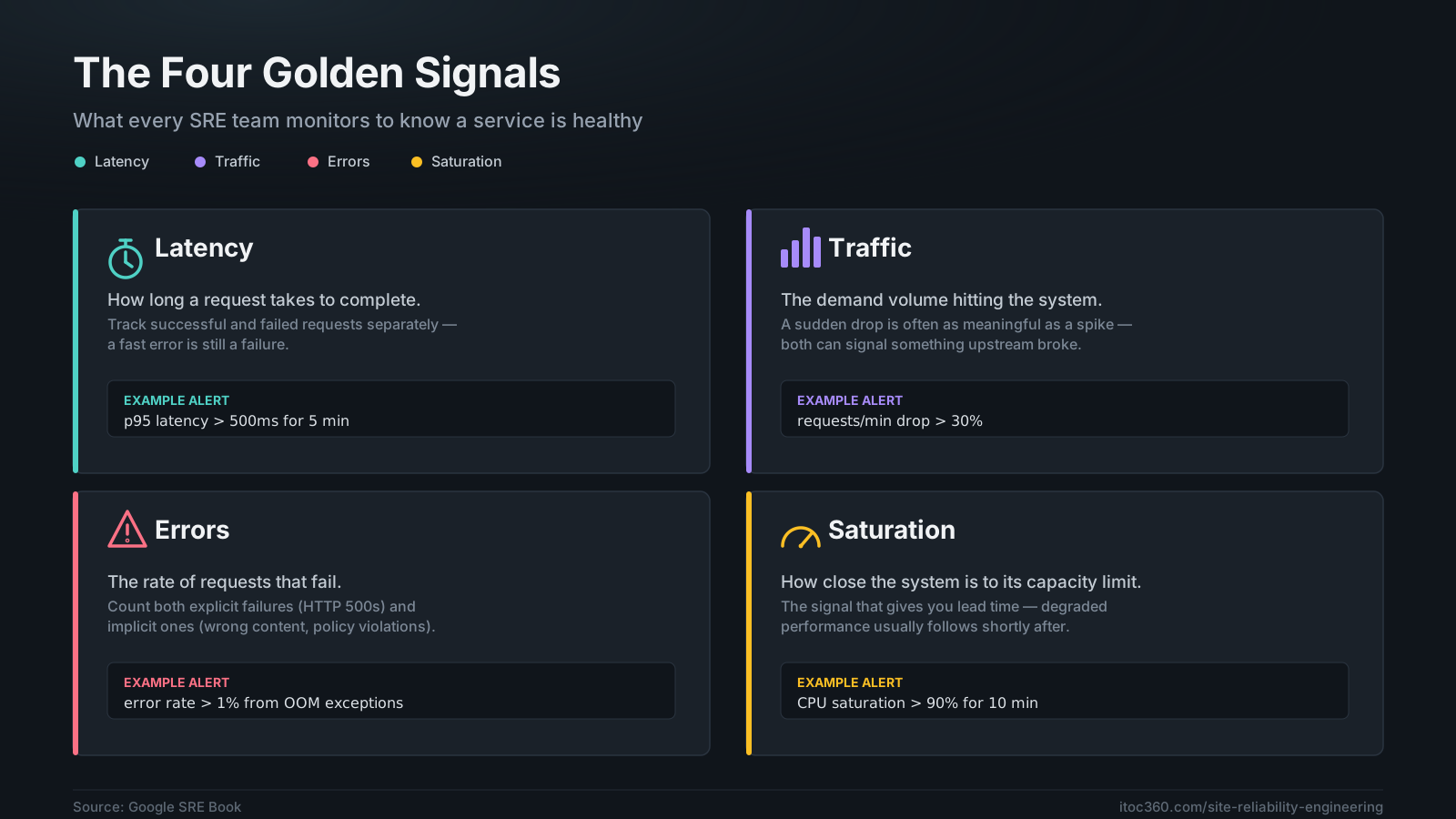
Google's SRE book identifies four metrics that, if measured consistently, give a complete picture of service health. If you can only track four things about a user-facing system, these are the four.
Signal | What it measures | Example alert |
|---|---|---|
Latency | How long requests take | API p95 latency > 500ms for 5 min |
Traffic | Demand volume | Requests per minute drop > 30% |
Errors | Failed request rate | Error rate > 1% from OOM exceptions |
Saturation | How close to capacity | CPU saturation > 90% for 10 min |
The key nuance on latency: distinguish between successful and failed requests. An HTTP 500 error served in 10ms is fast — but it's still a failure. Including failed request latency in your overall average produces misleading numbers.
Good alert design targets user-visible signals, not infrastructure metrics. Users care about slow responses and errors. They don't care about CPU usage unless that CPU usage causes a slow response.
The Benefits of Site Reliability Engineering
Teams that adopt SRE consistently report gains in a few specific areas:
Fewer, shorter outages. Golden-signal monitoring and error budgets catch degradation before it becomes a full incident, and structured on-call shortens the ones that still happen.
Faster, safer shipping. Because the error-budget policy makes the reliability-vs-features trade-off explicit, teams stop guessing whether it's safe to deploy — the data tells them.
Lower operational cost over time. Every toil item automated away is capacity that goes back into engineering work instead of repetitive manual tasks.
A measurable, negotiable definition of "reliable enough." SLOs replace vague reliability debates with a number both engineering and product leadership can agree on.
Reduced on-call burnout and attrition. Deliberate escalation policies, alert tuning, and fair scheduling directly target the leading causes of SRE turnover.
Better cross-team accountability. SLA, SLO, and SLI reporting gives leadership a clear, auditable answer to "how reliable is this service, really?"
SRE vs DevOps: What's the Difference?
The SRE vs DevOps question is common because both disciplines aim for the same outcome — faster, more reliable software delivery — but they operate at different levels.
DevOps | SRE | |
|---|---|---|
What it is | Cultural philosophy | Specific implementation |
Origin | Community movement (2008) | Google (2003) |
Focus | Collaboration + CI/CD pipeline | Reliability engineering |
Primary metrics | Deployment frequency, lead time | SLOs, error budgets, MTTA |
On-call ownership | Shared across dev teams | Owned by dedicated SRE function |
The simplest framing: DevOps tells you why development and operations should work together. SRE tells you how, with concrete practices and measurements.
Many organisations run both simultaneously. DevOps culture applies across all engineering teams. A dedicated SRE function owns reliability tooling, on-call processes, and SLO governance. The two reinforce rather than replace each other.
One data point worth noting: SREs earn 15–25% more than DevOps engineers at equivalent experience levels, according to KORE1's 2026 salary guide. Average US SRE compensation sits at $163,410 — reflecting both the technical depth required and the shortage of practitioners who can bridge engineering and operations at scale.
Who Becomes a Site Reliability Engineer?
Most SREs come from one of two backgrounds: software engineers who move toward production systems, or systems/infrastructure engineers who add coding skills. Google's own hiring model targets roughly this 50/50 split, and the same balance shows up in the day-to-day work.
The 50-50 rule. Google's guidance caps operational work — on-call, tickets, manual operations — at roughly half of an SRE's time. The other half is reserved for engineering work: writing automation, improving tooling, and reducing future toil. If operational load creeps past that line for a sustained period, the team is expected to shift work back to the owning development team until the balance is restored. This rule is what keeps SRE from quietly turning back into traditional, always-firefighting ops.
Typical skills and background:
Proficiency in at least one general-purpose language (Go, Python, Java, or similar) for writing tooling and automation
Solid Linux/systems fundamentals — networking, storage, containers, orchestration (Kubernetes is now close to a baseline expectation)
Familiarity with observability stacks (metrics, logs, traces) and incident tooling
Comfort with on-call, incident response, and blameless postmortems
A computer science degree or equivalent hands-on production experience is the typical bar, though the mix of formal education vs. self-taught practitioners varies widely by company
SRE On-Call: Where Theory Meets Reality
On-call is where SRE principles meet operational reality. It's also where many SRE practices break down. The statistics are uncomfortable:
62% of SREs report weekly sleep disruption from night pages
41% have considered leaving their job due to alert load
71% respond to dozens or hundreds of non-ticketed incidents per month
Engineers receive a median of 42 pages per week (pingfatigue.com, 2026)
These aren't just wellbeing concerns. Burnt-out on-call engineers make slower decisions, miss signals, and leave — taking institutional knowledge with them. The Google SRE Workbook recommends a maximum of 2–3 actionable incidents per on-call shift as a sustainable baseline.
MTTA is your primary on-call health metric
Mean time to acknowledge (MTTA) — the gap between an alert firing and an engineer confirming they're handling it — is the most direct indicator of on-call system health. Leading teams target MTTA under 5 minutes for P1 incidents. Teams using automated on-call alerting reduce MTTA by up to 60% compared to teams relying on manual monitoring. For the full breakdown of how MTTA relates to MTTR and MTTD, see our MTTA vs MTTR vs MTTD guide.
If MTTA is climbing, the root cause is almost always one of three things: alert routing misconfiguration, notification channel failures, or schedule gaps leaving no one on-call.
Build the on-call foundation deliberately
Four structural fixes prevent most on-call problems:
Define escalation policies before incidents happen. A clear policy routes alerts to the right person based on severity, team, and time of day. Without one, incidents trigger coordination chaos.
Set incident severity levels consistently. P1 through P4 tiers determine response time targets, who gets paged, and what actions are authorised — see our incident response lifecycle breakdown for how severity feeds each phase.
Audit alert fatigue quarterly. Any alert that fires more than twice per on-call shift without requiring action should be tuned or removed.
Distribute on-call scheduling fairly. Uneven burden distribution is the leading structural cause of SRE attrition.
The speed and reliability of the on-call platform matters more than most teams realise. When a P1 fires at 3 AM, an engineer needs an interface that loads instantly, presents the alert clearly, and makes acknowledgment a single tap. Seconds compound. itoc360's on-call management software is built specifically for these moments — purpose-built scheduling and escalation designed around the scenarios that determine whether MTTA stays under five minutes.
How to Implement SRE in Your Organisation
SRE adoption follows a predictable four-stage path regardless of team size.
Stage 1: Instrument before committing to targets
Before writing SLOs, understand your reliability baseline. What's your actual availability? Where are the slowest endpoints? What does "good" look like from a user perspective? Instrument first, set targets second — SLOs based on aspiration rather than measurement rarely survive first contact with reality.
Stage 2: Define SLOs for your most critical services
Start with one or two services, not the entire stack. Define SLIs (what to measure), SLOs (target values), and error budgets (permitted failure envelope). Keep first SLOs deliberately conservative — it's easier to tighten a target than to explain why you keep missing it. The SLA vs SLO vs SLI breakdown above is essential reading before this stage.
Stage 3: Build the on-call foundation
Define incident severity levels. Create an escalation policy. Set up an on-call rotation. Write runbooks for your five most common failure modes. These four steps reduce MTTA, MTTR, and on-call burnout faster than any other investment at this stage.
After every significant incident, run a blameless post-mortem to identify root causes and prevent recurrence. "Blameless" isn't cultural nicety — it's what makes engineers honest about failure modes instead of defensive about them.
Stage 4: Automate toil systematically
Identify the top three sources of repetitive manual operational work. Automate or eliminate one per quarter. Track toil percentage as a team metric — it should trend downward as the practice matures.
Two techniques mature this stage further:
Chaos engineering — deliberately injecting failure into production or pre-production systems (killing a service, adding latency, cutting a dependency) to confirm your system fails the way you think it will, before a real outage proves otherwise. Teams that skip this find out about their weak points during an actual incident instead of a controlled test.
Capacity planning — forecasting the infrastructure a service will need as traffic grows, based on historical usage and golden-signal trends, so scaling decisions are made ahead of demand rather than during a saturation-driven outage.
Our automated incident management guide covers the tooling patterns that accelerate this stage.
SRE in 2026: The AI-SRE Shift
The SRE discipline is changing faster in 2026 than at any point since Google published its book. Two forces are driving the shift.
AI-assisted incident response is moving from experiment to standard. Gartner's 2025 Market Guide forecasts that 85% of enterprises will use AI SRE tooling by 2029, up from less than 5% in 2025. Early adopters report AI agents correlating telemetry and generating root cause hypotheses in minutes for incidents that previously took hours.
The definition of reliability is expanding. The SRE Report 2026, based on 418 responses from reliability and DevOps professionals worldwide, found that 67% of respondents now agree that performance degradations are as damaging as outages. Slow isn't just annoying — it's down. The same report puts median toil at 34% of working time, with roughly half of respondents reporting AI has reduced their toil load.
The implications for SRE practice: SLOs need to include latency and experience metrics, not just availability. Error budgets need to reflect user-felt degradation. And on-call response needs to be fast enough to address performance problems before users notice — which means MTTA targets are getting tighter, not looser.
Conclusion
Site reliability engineering remains the most rigorous framework for running production systems at scale. The core model — measure, own, improve — hasn't changed since Google introduced it. What's changed is the stakes: AI systems, distributed architectures, and rising user expectations have made reliability harder to achieve and more expensive to lose.
Five things to take away from this guide:
SRE is what you get when you apply software engineering to IT operations — measure with SLIs, target with SLOs, and spend the error budget deliberately.
SLOs and error budgets make reliability negotiable and measurable. Start with one service, one SLI, one SLO.
The four golden signals (latency, traffic, errors, saturation) give you 80% of the visibility you need with 20% of the instrumentation effort.
On-call health is measurable. MTTA under 5 minutes for P1s is the benchmark. If yours is higher, the fix is usually structural — routing, scheduling, or alert quality.
Toil elimination compounds. Every manual task automated permanently reduces operational burden. Track it as a metric, and mature into chaos engineering and capacity planning once the basics are solid.
If you're building an on-call and incident management foundation for your SRE practice, itoc360 handles alert ingestion, escalation policy management, and on-call scheduling as first-class features — designed for the incident response scenarios where every second counts.
Frequently Asked Questions
What is site reliability engineering?
Site reliability engineering (SRE) is the practice of applying software engineering to IT operations so that production systems stay reliable, scalable, and automated. SRE teams define service level objectives (SLOs), manage error budgets, automate repetitive operational work, and own the on-call response process to minimise downtime and engineer burnout.
What is the difference between SRE and DevOps?
DevOps is a cultural philosophy encouraging collaboration between development and operations teams. SRE is a specific, engineering-driven implementation of that philosophy using SLOs, error budgets, and on-call management. DevOps tells you why to break silos; SRE tells you how.
What are the four golden signals in site reliability engineering?
The four golden signals are latency (how long requests take), traffic (demand volume), errors (failed request rate), and saturation (how close the system is to capacity). Monitoring all four simultaneously gives a complete picture of service health and catches most failure modes before they become incidents.
What is an error budget in SRE?
An error budget is the amount of unreliability an SLO permits. If a service has a 99.9% availability SLO, its error budget is 0.1% — approximately 43 minutes of downtime per month. When the budget is healthy, teams ship features. When it's burning, reliability work takes priority over new functionality.
What is an SLA, and how is it different from an SLO?
An SLA (service level agreement) is the external, contractual reliability promise made to customers, often with financial penalties attached. An SLO (service level objective) is the internal target a team sets to stay safely inside that promise. SLOs are always set tighter than SLAs so problems get caught before they become contractual breaches.
What is toil in site reliability engineering?
Toil is manual, repetitive, automatable operational work that scales linearly with service growth — things like manually restarting services, rotating certificates, or provisioning accounts. Google's SRE model targets keeping toil below 50% of working time. The SRE Report 2026 puts the current industry median at 34%.
What are the benefits of site reliability engineering?
SRE delivers fewer and shorter outages, faster and safer feature shipping, lower long-term operational cost through toil automation, a measurable definition of "reliable enough," reduced on-call burnout, and clearer cross-team accountability for service reliability.
Who becomes a site reliability engineer, and what is the 50-50 rule?
SREs typically come from software engineering or systems/infrastructure backgrounds, combining coding ability with production operations experience. The 50-50 rule, from Google's original model, caps operational work at roughly half an SRE's time — the other half is reserved for engineering work that reduces future toil.
What is chaos engineering, and how does it relate to SRE?
Chaos engineering is the deliberate injection of failure into a system — killing a service, adding latency, cutting a dependency — to verify it fails the way you expect, before a real outage tests it for you. It's a maturity practice SRE teams adopt once basic SLOs and on-call foundations are in place.
How long does it take to implement SRE?
A basic SRE foundation — SLOs for critical services, an on-call rotation, and escalation policies — can be operational in 30 to 90 days. Mature SRE practices with full toil automation, chaos engineering, and capacity planning typically take 6 to 12 months of sustained effort. Start with one service, one SLO, and one escalation policy. Everything else builds from there.
Related reading
SLA vs SLO vs SLI: What They Mean and Why the Difference Matters
MTBF (Mean Time Between Failures): Formula, Calculation, and How to Improve It
Playbook vs. Runbook: The Guide to Incident Response Management
Automated Incident Management: The Complete Guide for DevOps & SRE Teams
Incident Management KPIs: The Only Metrics That Actually Matter