SRE vs DevOps: Key Differences & How They Work Together (2026)

Quick answer: DevOps is a culture and set of practices that brings development and operations together to ship software faster and more safely. SRE (site reliability engineering) is a specific way of doing that, started at Google, which treats operations as a software engineering problem and manages reliability with measurable targets: SLOs, error budgets and limits on manual work. DevOps says what good delivery looks like; SRE says how to run it reliably. Google sums it up as "class SRE implements interface DevOps". They aren't rivals, and most organizations use both.
Ask ten engineers how SRE differs from DevOps and you'll get ten answers. Some say SRE is DevOps with a pager. Others say DevOps is a philosophy and SRE is a job. Job ads often use the titles interchangeably, which doesn't help.
The confusion is understandable, because the two overlap heavily. Both want fewer silos, smaller changes, more automation and better measurement. The real difference is focus: DevOps optimizes the flow of changes into production, while SRE protects how those changes behave once they're there.
This guide explains the difference in practical terms: the definitions, a side-by-side comparison, how SRE puts DevOps principles into practice, what each role actually does day to day, the metrics each one owns, how real companies organize them, and where platform engineering fits in. These four describe how well a team ships. How to improve them in practice, from automation to rollback triggers, is covered in our guide to release management best practices.
What is DevOps?
DevOps is a set of cultural practices and tools that removes the wall between the people who build software and the people who run it. The goal is to deliver changes quickly, safely and often, with the same team responsible for code from commit to production.
The term spread from the first DevOpsDays conference in Belgium in 2009, as a reaction to the old model where developers "threw code over the wall" to an operations team. In practice, DevOps shows up as shared ownership, continuous integration and delivery, infrastructure as code, automated testing and fast feedback from production. It deliberately doesn't prescribe one way of doing any of these.
What is SRE?
Site reliability engineering (SRE) is an engineering discipline for running production systems reliably at scale. It began at Google in 2003, when Ben Treynor Sloss was asked to run a production team and staffed it with software engineers. His often-quoted definition: SRE is "what happens when you ask a software engineer to design an operations team."
SRE is more specific than DevOps. It comes with concrete practices:
Service level objectives (SLOs) that define how reliable a service needs to be.
Error budgets that turn the gap between 100% and the SLO into a budget for risk.
Limits on toil, the repetitive manual work that doesn't scale; Google caps it at 50% of an SRE's time.
Blameless postmortems after incidents.
Engineering work to automate operations, rather than adding people as systems grow.
Our guide to site reliability engineering covers SRE in depth.
SRE vs DevOps: the key differences
DevOps | SRE | |
|---|---|---|
What it is | A culture and set of practices | A specific engineering discipline and, usually, a job role |
Main goal | Deliver changes faster and more safely | Keep production reliable at the level users need |
Core question | "How do we ship this quickly and safely?" | "How reliable does this need to be, and are we on target?" |
Origin | DevOpsDays community, 2009 | Google, 2003 |
How it's defined | Principles, deliberately flexible | Concrete practices: SLOs, error budgets, toil limits |
Primary focus | The path from commit to production | What happens in production |
Key metrics | Deployment frequency, lead time, change failure rate, recovery time (DORA) | SLO attainment, error budget burn, toil share, incident response times |
Attitude to failure | Make changes small so failures are cheap | Accept a set amount of failure (the error budget) and spend it deliberately |
Typical people | Everyone on a product team; sometimes "DevOps engineers" | Dedicated SREs with software and operations skills |
Owns on-call? | Often the product team that built the service | Often shared: SREs take the pager for critical services they support |
The simplest way to remember it: DevOps is about speed of change; SRE is about safety of change. Both care about both, but each starts from a different end.
How SRE implements DevOps
Google's SRE Workbook describes the relationship with a programming metaphor: "class SRE implements interface DevOps". DevOps defines the interface, a set of principles. SRE is one concrete implementation of them.
The Workbook lists five DevOps principles and shows how SRE puts each into practice:
DevOps principle | What it means | How SRE implements it |
|---|---|---|
Reduce organizational silos | Development and operations share ownership of production | SREs and developers share responsibility for a service, and SREs spend most of their time on engineering, not tickets |
Accept failure as normal | Failures will happen; plan for them | Error budgets set how much failure is acceptable, and blameless postmortems learn from each one |
Implement gradual change | Small, frequent changes are safer than big releases | Canary releases and progressive rollouts, with the error budget deciding how fast to go |
Leverage tooling and automation | Automate repetitive work | A cap on toil, and engineering time spent removing manual work |
Measure everything | Decisions should be based on data | SLIs and SLOs that measure reliability from the user's point of view |
This is why the "SRE vs DevOps" framing is a little misleading. An organization can practise DevOps without SRE, but SRE without DevOps principles doesn't really work: an SRE team cut off from development becomes just another operations silo.
DevOps engineer vs SRE: day-to-day work and skills
Job titles vary a lot between companies, so treat this as a typical picture rather than a rule.
DevOps engineer | Site reliability engineer | |
|---|---|---|
Spends most time on | CI/CD pipelines, infrastructure as code, developer tooling, environments | SLOs, monitoring and alerting, capacity, incident response, reliability engineering projects |
A typical week | Speed up a slow build, add a deployment stage, automate a new environment | Review an SLO that's burning too fast, lead a postmortem, automate a recurring manual fix |
On-call | Sometimes, often for the delivery platform | Usually, for the production services they support |
Success looks like | Developers ship more often, with fewer failed deployments | Services meet their SLOs while the team keeps shipping |
Core skills | CI/CD tools, containers and Kubernetes, Terraform or similar, scripting, cloud platforms | Programming, distributed systems, observability, incident management, capacity planning |
Writes code? | Mostly automation and configuration | Yes; Google expects SREs to spend at least half their time on engineering |
The biggest practical difference is incidents. SREs are typically the people who set up on-call for critical services, run the incident process when things break, and turn what they learn into engineering work. DevOps engineers are more often focused on making the path to production fast and safe, so fewer of those incidents happen in the first place.
The metrics each one owns
The clearest way to see the difference is to look at what each side measures.
DevOps metrics: the DORA keys. The DORA research program, now part of Google Cloud, has studied software delivery performance for more than a decade. Its core metrics describe how well changes flow to production:
DORA metric | What it measures |
|---|---|
Deployment frequency | How often you release to production |
Change lead time | How long a change takes from commit to production |
Change failure rate | Share of deployments that cause a failure in production |
Failed deployment recovery time | How long it takes to recover when a deployment fails |
SRE metrics: reliability as users experience it.
SRE metric | What it measures |
|---|---|
SLO attainment | Whether a service met its reliability target, such as 99.9% of requests succeeding |
Error budget burn | How fast the allowed failure is being used up; see error budgets |
Toil share | Share of engineering time spent on repetitive manual work |
MTTD, MTTA, MTTR | How quickly incidents are detected, acknowledged and resolved; see the MTTR, MTTA, MTBF and MTTD guide |
Where they meet: change failure rate and recovery time sit on both lists, because most incidents start with a change. A team that ships often (good DevOps) but breaks things often will burn its error budget (an SRE signal), and the error budget policy then slows releases until reliability recovers. That feedback loop is where DevOps and SRE work best together.
How companies actually organize SRE and DevOps
In practice, "SRE vs DevOps" is rarely a choice between two teams. It's a question of who owns production reliability. These are the most common models, several of which Google's SRE Workbook also describes:
Model | How it works | Fits when | Watch out for |
|---|---|---|---|
You build it, you run it | Product teams own their services end to end, including on-call. No separate SRE team | Small to mid-sized companies; teams with strong operational skills | Reliability practices vary team by team; on-call load can be uneven |
Embedded SRE | An SRE sits inside a product team, sharing its goals and on-call | A few critical services need deeper reliability expertise | SREs get pulled into feature work and lose focus |
Central SRE team | One SRE team runs or co-owns the most critical services, often with a formal handover | Large organizations with clear tier-1 services | Can become an operations silo if developers stop owning production |
Consulting SRE | SREs advise many teams on SLOs, alerting and incident practice, without owning services | Many teams, few SREs | Advice without ownership can be ignored |
Platform team plus SRE | A platform team builds shared tooling; SREs focus on reliability standards and incidents | Fast-growing engineering organizations | Unclear boundaries between platform and SRE work |
Most companies start with "you build it, you run it" and add SREs as the number of critical services grows. A common trigger is the first time an outage costs serious money or a contract requires a formal SLA.
From the field: In high-performing engineering orgs, DevOps owns the delivery velocity—building the CI/CD pipelines and deployment automation while SRE owns production reliability, defining SLOs, error budgets, and incident response. The key is avoiding a handoff wall; both teams share the same telemetry and observability stack so reliability is baked in before code ever hits production." — CTO at ITOC360
Whatever the model, two things decide whether it works: who carries the pager for each service, and whether that person has the authority to slow down releases when reliability slips.
SRE vs DevOps vs platform engineering
Platform engineering is the newest of the three, and it's often added to the comparison.
DevOps | SRE | Platform engineering | |
|---|---|---|---|
Focus | How teams deliver software | How production stays reliable | The internal tools developers use to build and run software |
Main output | Practices and pipelines | SLOs, incident response, reliability engineering | An internal developer platform: templates, self-service environments, paved roads |
Customer | The whole engineering organization | Users of the production service | Internal developers |
Success looks like | Faster, safer delivery | Services meet their SLOs | Developers ship without needing to understand the infrastructure underneath |
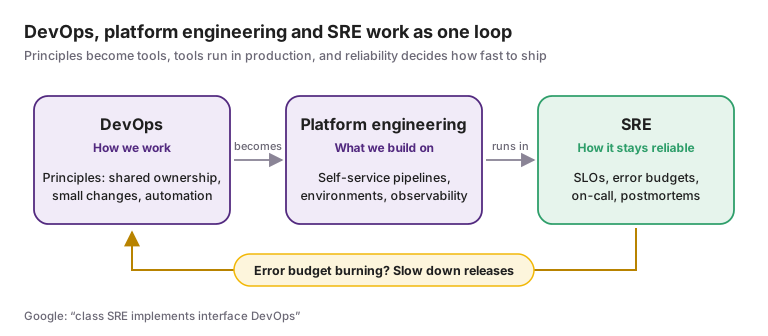
The three fit together naturally. DevOps sets the principles. Platform engineering turns them into self-service tools, so every team gets CI/CD, environments and observability without building them. SRE makes sure what runs on that platform stays reliable, and often defines the reliability standards the platform builds in, such as default alerts, SLO templates and on-call integration.
In smaller companies one team often does all three. The distinction starts to matter when an engineering organization grows past a few dozen people.
Which is right for you?
For a team: do you need SREs?
Most teams should start with DevOps practices and add SRE practices before they add SRE people. SLOs, error budgets and blameless postmortems work in any team. Dedicated SREs start to pay off when several of these are true:
Some services are critical enough that an hour of downtime has a clear business cost, or a customer contract sets an SLA.
Product teams are carrying an on-call load that keeps them from feature work, or burning out.
The same kinds of incidents keep coming back because nobody owns the fixes.
Manual operational work is growing faster than the team.
For a career: SRE or DevOps?
Is SRE better than DevOps? Neither is better; they suit different interests. If you enjoy building pipelines, automation and developer tooling, DevOps and platform roles fit well. If you're drawn to production systems, debugging under pressure, distributed systems and measuring reliability, SRE is the closer match. The skills overlap enough that moving between them is common.
Is DevOps a part of SRE? It's the other way round. DevOps is the broader set of principles; SRE is one way of putting them into practice.
Is DevOps a dead-end job? No, but the title is changing. Much of what "DevOps engineers" did is now called platform engineering, and the underlying skills, such as automation, infrastructure as code and CI/CD, remain in demand under different names.
Will AI replace SRE jobs? AI is already taking over parts of the work: summarizing incidents, suggesting likely causes, drafting postmortems and writing automation. Those are useful, and they reduce toil. The parts that are hardest to automate are the ones SRE is built around: deciding how reliable a service needs to be, designing systems that fail safely, leading an incident when the facts are unclear and making trade-offs between speed and risk. Nobody can predict the job market with certainty, but the role is more likely to change shape than disappear.
Where ITOC360 fits
Whichever model you choose, someone has to be reached when production breaks, and the response has to be organized. That's the part ITOC360 handles, for DevOps teams that run their own services and for dedicated SRE teams alike:
On-call that matches your model. Schedules and escalation per service, whether the pager sits with a product team, an embedded SRE or a central SRE team, in ITOC360 On-Call.
Less noise for whoever is on call. Related alerts from your monitoring tools are grouped into one incident in ITOC360 Alerting.
A consistent incident process across teams, with roles, a timeline and status page updates in ITOC360 Incident Response.
The SRE metrics, measured for you: MTTA and MTTR for every incident, by service and team.
ITOC360 is certified to ISO 27001, ISO 9001 and ISO 14001. See more: Security
Frequently asked questions
What is the difference between SRE and DevOps?
DevOps is a culture and set of practices for delivering software quickly and safely by bringing development and operations together. SRE is a specific discipline, started at Google, that applies software engineering to operations and manages reliability with SLOs, error budgets and limits on manual work. DevOps focuses on the flow of changes; SRE on how production behaves.
Is SRE the same as DevOps?
No, but they're closely related. Google describes SRE as one implementation of DevOps principles: "class SRE implements interface DevOps".
Is SRE better than DevOps?
Neither is better. They solve different problems and usually work together. As careers, they suit different interests: delivery and tooling for DevOps, production reliability and incident response for SRE.
Is DevOps a part of SRE?
It's the other way round: DevOps is the broader set of principles, and SRE is one way to put them into practice.
Do SREs write code?
Yes. Google expects SREs to spend at least half their time on engineering work, such as automation, tooling and reliability improvements, rather than manual operations.
What metrics do SRE and DevOps teams use?
DevOps teams commonly use the DORA metrics: deployment frequency, change lead time, change failure rate and failed deployment recovery time. SRE teams use SLO attainment, error budget burn, toil share and incident metrics such as MTTD, MTTA and MTTR.
What is the difference between SRE, DevOps and platform engineering?
DevOps sets the principles for delivery, platform engineering builds the internal tools that let developers follow them through self-service, and SRE keeps the production services running on those tools reliable.
Will AI replace SRE jobs?
AI is automating parts of the work, such as incident summaries and suggested causes, which reduces toil. Setting reliability targets, designing systems that fail safely and leading incidents involve judgment that is much harder to automate, so the role is more likely to change than disappear.
Does a small company need an SRE team?
Usually not at first. Small teams can adopt SRE practices, such as SLOs, error budgets and blameless postmortems, within their DevOps teams, and hire dedicated SREs once critical services, SLAs or on-call load demand it.
Sources
Google SRE Workbook: How SRE Relates to DevOps ("class SRE implements interface DevOps" and the five principles)
Google SRE Book: Introduction (Ben Treynor Sloss's definition, the 50% cap on operational work)
Google SRE Workbook: Team Lifecycles (SRE engagement models)
DORA research program (software delivery performance metrics)